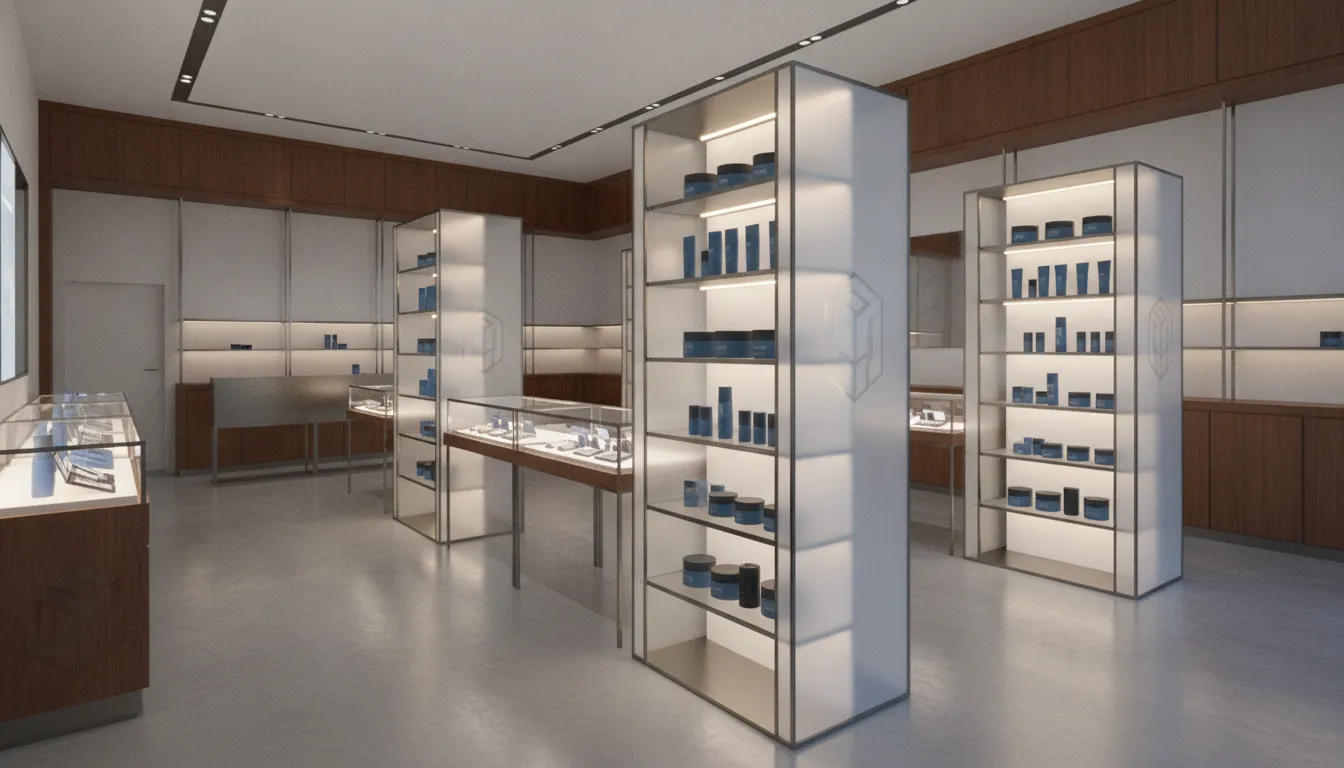


In beauty retail, a display case has to do more than make a product visible. It must help shoppers see color and detail, give associates a workable path to the merchandise, protect high-value items, and hold up across locations with different traffic patterns and store conditions.
Explore custom cosmetic display case solutions for your retail program
The right custom cosmetic display cases balance security, lighting, materials, merchandising capacity, and rollout requirements. Start with the product line and store workflow, then match access controls, shelves, compartments, finishes, and illumination to those realities rather than selecting a case from appearance alone.
For a multi-location program, the strongest specification connects the customer experience to operational control. That means reviewing how products are accessed, replenished, and inspected before finalizing the design. Security is the first decision because it shapes visibility, staff workflow, and the level of protection the case must provide.
Security for a beauty display case should protect valuable cosmetics without turning the fixture into a barrier between shoppers and the product. The right approach combines controlled access, clear sightlines, and a staff workflow that fits the pace of the store. S-CUBE documents secure cases with integrated lighting for beauty and cosmetics retailers, making security and product presentation part of the same fixture decision.
Start by defining which products require restricted access. Premium skincare, fragrance, complexion products, and limited-release collections may need a different access plan from everyday items that shoppers can handle freely. The case should make that distinction operationally clear. Staff need to know which areas they can open, when access is appropriate, and how products are returned to their intended position after a customer interaction. That reduces avoidable confusion without claiming that any single fixture eliminates loss.
Visibility remains essential. A locked case should let shoppers see packaging, shades, sizes, and key product differences from the normal approach path. Avoid a security layout that creates deep visual obstructions or forces staff to remove an entire assortment for one item. For cosmetics, sightlines also support comparison between closely related products, while integrated lighting can help the display remain legible in varied store conditions.
Access planning should account for the people who use the case every day. Visual merchandising leaders are balancing brand expression, customer experience, security, merchandising flexibility, functionality, and budget. Procurement teams are also weighing vendor reliability and risk reduction. Those priorities point toward a project-specific access strategy rather than an assumed hardware package. Confirm door or panel locations, service clearances, replenishment needs, and the number of staff members who require access during a typical shift.
For a broader discussion of protecting high-value merchandise while preserving visibility and retail operations, review this guide to locked display case security. A cosmetic-specific program should then layer in shade visibility, tester handling, and the daily workflow of beauty associates.
Lighting in a cosmetic case should do more than make the fixture look bright. It should help shoppers see packaging, finishes, and shade differences while keeping products legible from the intended viewing distance. That requires coordination between the light source, case geometry, shelf layout, surrounding store lighting, and the way customers evaluate products.
Integrated LED luminaires are a practical starting point for many programs because high-performance LED systems and controls can provide adequate display illumination while reducing connected load and ongoing energy consumption, according to the U.S. Department of Energy. The same specification references the CIE method for measuring and specifying color-rendering properties, which is a useful reminder that brightness alone is not an adequate lighting criterion. Review the lighting specification when developing the technical requirements for a case program.
Color rendering deserves particular attention in cosmetics. A peer-reviewed study found that the light source significantly influenced lipstick color preference and purchase intention. Its testing evaluated 15 lipsticks under five light sources with correlated color temperatures ranging from 2,500 K to 6,500 K. That evidence supports testing representative products under the proposed lighting, not selecting a single color temperature by habit. The right result is project-dependent and should account for the retailer's product mix, finish palette, store environment, and customer experience goals.
Ask the design team to assess shadows, glare, reflections, hot spots, and consistency across shelves. Test foundation, lipstick, gloss, and other representative packaging at different shelf positions and shopper sightlines. Controls may also help teams manage operating conditions or coordinate lighting with the broader store environment, but the control strategy should be defined during design rather than added after fabrication.
Lighting should be reviewed alongside tester placement, shopper flow, materials, and countertop units. These elements are part of effective beauty store fixture planning. For a multi-location rollout, document the approved light source, rendering requirements, controls, mounting details, and test criteria so each case supports a consistent product experience. In this context, custom cosmetic display cases are successful when lighting improves both visibility and confident shade evaluation without overwhelming the merchandise.
Material selection should follow the job the case must perform, not a default preference for glass or acrylic. Beauty merchandise may need strong visibility, controlled access, resistance to handling, a specific brand finish, or compatibility with testers and cleaning routines. Store conditions matter too. A countertop unit in a high-touch location has different demands from a locked floor-standing case near a feature wall.
Clear materials are often evaluated first because cosmetics depend on color, packaging detail, and visual confidence. Acrylic can provide 92 to 98 percent light transmission, according to the University of Pennsylvania's materials guidance, while offering a lighter alternative to glass. It is impact and shatter resistant, but it remains brittle, so edge details, mounting, and expected handling should be reviewed during design. Cast acrylic may offer somewhat better clarity, chemical resistance, and heat resistance than extruded acrylic, while extruded sheet can provide more consistent thickness across the sheet. Those distinctions are project inputs, not universal reasons to choose one fabrication method.
| Material | Useful strengths | Evaluate before specifying |
|---|---|---|
| Glass | High visual clarity and a premium presentation | Weight, handling, security design, and installation conditions |
| Acrylic | High light transmission, fabrication flexibility, and lower weight than glass | Brittleness, cleaning chemistry, heat exposure, and edge protection |
| Polycarbonate | A clear material option when impact performance is a priority | Required clarity, surface finish, scratching, and product environment |
| Wood and laminates | Warmth, structure, and alignment with store finishes | Brand finish, moisture, load requirements, and cleaning conditions |
| Metal | Structural support, framing, and durable visual accents | Weight, coating, corrosion exposure, and touch-point finish |
| Mixed media | Combines visibility, structure, security, and brand expression | Joints, tolerances, assembly, service access, and rollout consistency |
Polycarbonate, glass, hardwood, laminates, melamine, steel, aluminum, wire, coatings, and custom color matching are all documented material capabilities for S-CUBE programs. That range supports a mixed-media approach when a single material cannot meet every requirement. For example, transparent panels may support product visibility, while a wood or laminate base establishes the brand finish and metal components provide structure. The right combination depends on the case geometry, access method, product weight, and store environment.
Finish and chemistry deserve attention in cosmetics retail. Oils, alcohol-based products, cleaners, and repeated wiping can affect how surfaces look over time, so the specification should identify the products and cleaning process expected in stores. Procurement and visual merchandising teams should also review how samples look under actual store lighting, how edges and joints read at shopper distance, and whether replacement components can be produced consistently. S-CUBE's design and engineering process includes material selection, finish recommendations, prototypes, durability review, material optimization, and manufacturing specifications, helping teams resolve those tradeoffs before a larger rollout.
Plan a secure, lit cosmetic case program with S-CUBE
A beauty case has to do more than hold inventory. It should present color, finish, and packaging clearly while giving associates a practical way to replenish products, manage testers, and answer shopper questions. That balance starts with the product assortment. Lip balm, mascara, palettes, and small boxed items may need different compartments, clearances, and presentation angles, so a single undifferentiated shelf can waste usable space and make the assortment harder to shop.
Multi-tiered structures, compartments, and angled lids can be configured around a product line and its shelf presence. Use tiers to keep rear products visible without raising the front row so high that it blocks labels or shades. Compartments help separate sizes, collections, or testers, while custom inserts can hold products upright and reduce movement during display or transit. The insert should support the product without overwhelming the visual presentation or making replenishment unnecessarily slow.
Testers require their own logic. Place them where shoppers can reach and compare them without forcing staff to cross the case or disrupt adjacent merchandise. Keep tester items visually connected to the sellable products they represent, but define a clear boundary between sampling and protected inventory. For valuable cosmetics, sightlines should remain open from the shopper approach and the associate position. Secure cases with integrated lighting are a documented need for beauty and cosmetics retailers, making access planning inseparable from visibility and security.
A countertop unit can extend the main case into a compact point-of-purchase moment for featured products, trial items, or seasonal edits. Countertop cosmetic displays can support compact presentation and shopper engagement, but they should still follow the assortment's tier, compartment, and replenishment logic. Coordinate the countertop height, finish, and sightline with the primary case so the two elements read as one merchandising system rather than unrelated fixtures.
For multi-location programs, document the shelf spacing, insert geometry, tester position, access method, and countertop relationship before production. That detail protects consistency while leaving room for product-specific adjustments as the assortment changes.
A successful rollout treats custom cosmetic display cases as a coordinated program, not a single production order. The plan should connect store requirements, design decisions, engineering, quality control, logistics, and field verification so every location receives the right case configuration at the right time. That matters especially when a beauty retailer has different footprints, SKU mixes, installation conditions, or release dates across regions.
For procurement and visual merchandising teams, the value of this sequence is control. It creates clear decision points before production, limits avoidable rework, and gives regional and national teams a common standard while leaving room for documented store-level differences.
A strong specification gives the fixture team enough detail to evaluate the display as part of the store, not as an isolated box. Start with the products and the operating conditions, then define how the case should support merchandising, security, replenishment, and rollout control.
Sharing this information lets the team develop renderings, CAD, prototypes, and manufacturing specifications around the actual retail program.
Discuss your custom cosmetic display case requirements with S-CUBE
Start with the product mix, SKU dimensions, tester requirements, access points, security needs, lighting goals, finishes, store conditions, quantities, and rollout locations. Also define who will install the cases and how success will be checked after the pilot.
Yes. A case can be planned around controlled staff access, clear sightlines, and integrated lighting so valuable products remain visible without leaving them fully exposed. The right balance depends on merchandise value, customer interaction, and store operating procedures.
There is no universal best material. Acrylic and glass support visibility, while metals, wood, plastics, and mixed-medium construction can add structure, durability, or brand character. S-CUBE documents capabilities across acrylic, polycarbonate, glass, hardwood, laminates, steel, aluminum, wire, and custom finishes, so selection can follow the product, environment, and brand requirements.
Evaluate the case under the store's actual lighting conditions, especially when color accuracy affects product choice. A peer-reviewed lipstick study found that light source significantly influenced color preference and purchase intention, and tested five light sources across correlated color temperatures from 2,500 K to 6,500 K (peer-reviewed lighting study). Test samples rather than applying one color-temperature rule to every store.
Timing depends on design approval, engineering, prototyping, materials, quantities, shipping, and installation. S-CUBE documents custom-program timing of 6 to 10 weeks from design approval, with expedited options available, but each rollout should receive its own schedule and milestone plan.
The right case program brings security, lighting, merchandising, and rollout requirements into one practical plan. Tell us about your custom cosmetic display case project so the discussion can focus on your products, stores, materials, and operating needs. Contact us about your custom retail fixture program to get started.
Subscribe for expert insights on fixture design, materials, and modern retail environments.