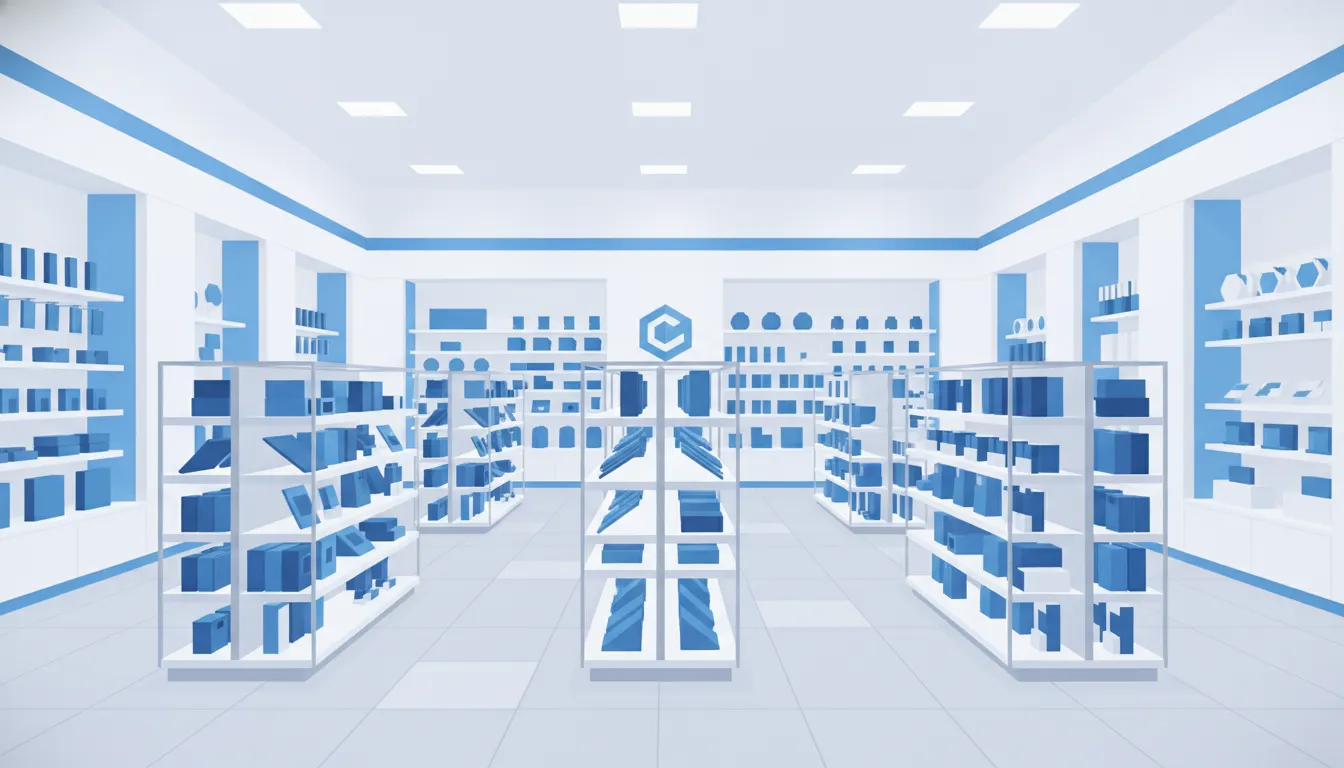


Retail fixtures do more than hold merchandise. They shape sightlines, guide movement, and determine whether products are easy to browse, compare, and select. The right rack also has to support the realities of a rollout: consistent construction, dependable capacity, and a format that fits the store plan.
display racks are purpose-built retail fixtures, available in freestanding and wall-mounted formats, that organize merchandise while presenting it at the point of purchase. The best choice depends on product weight, available floor or wall space, brand presentation, replenishment needs, and the scale of the store program.
From gondola and grid systems to custom wood, metal, acrylic, and wire solutions, each format creates a different merchandising advantage. Understanding how the major rack types work is the first step toward selecting fixtures that balance customer access, visual impact, durability, and rollout efficiency.
Explore custom retail fixture solutions
A retail display rack is a purpose-built fixture that organizes merchandise and presents it where shoppers can see, reach, and evaluate it. Racks may be freestanding or wall-mounted, and common construction materials include metal, wood, wire, and acrylic. Unlike a basic storage shelf, a well-designed rack supports both product organization and shopper interaction, helping move merchandise from the sales floor into the customer's hands.
That distinction makes display racks the backbone of in-store merchandising. They give each product category a defined place while shaping how customers move through the store and encounter products. A rack can frame a collection, separate departments, create a focal point. Or bring a high-priority item into a shopper's natural sightline without requiring a major change to the store footprint.
Retail space is expensive, so every fixture must earn its footprint. Display racks use vertical and horizontal space more efficiently than loose floor merchandising, allowing retailers to present more products within a controlled area. Wall-mounted racks preserve valuable walkways and perimeter space, while floor-standing and rotating models add capacity where shoppers already browse. The right configuration increases usable merchandising area without making aisles difficult to navigate.
Rack selection should follow the merchandise and the layout, not the other way around. Smaller accessories may work well on a compact or rotating unit. Larger or heavier products need a stable floor fixture. A wall system may be appropriate for packaged goods that shoppers can easily lift, while an open wire rack can make a broad assortment easy to scan. These choices connect display capacity to actual shopping behavior.
Visibility is a merchandising advantage. Display racks elevate products, organize them into understandable groups, and make key items easier to notice as shoppers move through the store. Research summarized in the retail fixture industry shows that racks can maximize floor space while improving product visibility. When merchandise is visible and accessible, shoppers are more likely to pause, pick it up, compare options, and consider an unplanned purchase.
That physical interaction is especially important for impulse-driven categories. A rack positioned near a high-traffic path can turn an overlooked accessory or seasonal item into a useful add-on. The goal is not to fill every available surface. It is to create a clear, purposeful presentation that supports the product, the brand, and the shopper's next decision.
Display racks also contribute to operational consistency. Their dimensions, finishes, load requirements, and anchoring methods should be planned for the store environment and the products they carry. Retailers introducing electrical components, lighting, or interactive features should also account for applicable fixture safety requirements. UL's retail fixtures and merchandise displays reference guide provides context on standards for commercial displays and related merchandising equipment.
For multi-location retailers, a consistent rack program can reinforce brand presentation from one store to the next while still allowing adjustments for local floor plans. The result is a merchandising system that uses space intelligently, keeps products visible, and gives shoppers more reasons to engage.
The right rack depends on two related decisions: how densely the store must merchandise product and how much physical interaction shoppers should have with it. Wall-mounted formats conserve floor area, while floor-standing and rotating formats invite browsing from multiple sides. The main categories below provide a practical starting point for planning a department, promotional zone, or complete store rollout.
| Rack type | Best use | Common products | Advantages |
|---|---|---|---|
| Wall racks | High-density merchandising along perimeter walls | Apparel, accessories, packaged goods | Preserve aisle space, use vertical area efficiently, and keep merchandise visible without adding a floor obstacle. |
| Floor or floor-standing racks | Feature zones, aisle merchandising, and flexible product presentation | Clothing, footwear, home goods, seasonal merchandise | Offer strong visibility from the sales floor, support larger or heavier assortments, and can be repositioned as the layout changes. |
| Countertop racks | Checkout areas and small-footprint point-of-purchase displays | Small accessories, cosmetics, snacks, and add-on items | Turn underused counter space into an interaction point and make compact products easy to browse. |
| Gondola racks | Open aisles and organized department merchandising | Grocery, pharmacy, convenience, and general merchandise | Double-sided, aisle-facing construction creates substantial selling capacity and supports a clear shopping path. |
| Slatwall racks | Modular wall systems that need frequent merchandising changes | Apparel, sporting goods, accessories, and packaged products | Adjustable hooks, shelves, and brackets allow one wall to support different product sizes and seasonal campaigns. |
| Grid or four-way racks | Central apparel presentation and compact, accessible feature displays | Garments, folded apparel, accessories, and promotional items | Open wire construction improves visibility, while four-sided access encourages shoppers to browse around the fixture. |
These categories are not interchangeable in every environment. Wall-mounted and floor-standing racks are established options with distinct merchandising purposes, as documented by Creative Store Solutions (display rack configurations). Rotating formats can also increase product capacity in a smaller footprint, particularly when shoppers benefit from browsing around the fixture. Gondolas are typically the workhorse for aisle-facing retail, while slatwall and grid systems are valuable when assortment flexibility matters more than fixed presentation.
For a multi-department or multi-location program, the most effective solution may combine several rack types rather than standardize on one. A custom retail fixture manufacturer can coordinate those formats with product dimensions, traffic flow, brand standards, and installation requirements so the fixture plan supports both density and shopper interaction.
Material selection affects more than the appearance of a display. It influences how a rack performs under daily use, how merchandise is presented. How easily the fixture can be maintained, and how the investment fits the broader store program. Metal, wire, wood, and acrylic are among the most common materials used for display racks, each offering a different balance of durability, aesthetics, visibility, and cost. Material research on retail display racks confirms that these choices are typically made to balance visual appeal with functional performance.
Metal is often the strongest choice for floor-standing racks, heavy merchandise, and stores that expect frequent customer interaction. Steel and other metal constructions can support demanding applications while maintaining a precise, structured appearance. The material also accommodates finishes and modular components that make it easier to align a fixture with a brand system or adjust merchandising over time.
For high-traffic locations, durability can reduce the disruption and replacement expense associated with damaged fixtures. Metal may carry a higher initial cost than simpler wire construction. But its service life and load-bearing capability can make it the more practical choice when reliability matters most.
Wood brings texture, warmth, and a more substantial visual presence to the selling environment. It works well for premium, lifestyle, home, apparel, and specialty retail concepts where the fixture itself should reinforce the brand story. Wood can be shaped, stained, painted, or paired with metal and glass to create a distinctive merchandising environment rather than a purely utilitarian rack.
The tradeoff is that wood generally requires more attention to finish quality, edge protection, and cleaning conditions. When designed correctly, however, it can create a durable, brand-forward solution that supports a consistent experience across multiple locations.
Acrylic is clear, lightweight, and modern. It allows products and graphics to remain visually prominent while reducing the visual weight of the fixture. That makes it useful for cosmetics, accessories, packaged goods, and countertop applications where open sightlines are important. Acrylic can be vulnerable to scratching or impact, so the design should match the expected traffic and handling conditions.
Wire is an economical option with an open construction that keeps merchandise visible from multiple angles. It is especially useful when retailers need efficient product capacity, ventilation, or fast-turn fixture production. Wire can look less substantial than wood or finished metal, but coatings, accessories, and thoughtful merchandising can give it a clean, consistent appearance.
The best material is the one that fits the product, traffic level, brand, maintenance plan, and rollout budget together. Mixed-medium construction can provide the strongest result, such as a metal frame with wood panels, acrylic shelves, or wire baskets. S-CUBE builds in wood, metal, acrylic, glass, wire, and mixed mediums, allowing the fixture specification to follow the merchandising strategy rather than forcing every application into one material.
Safety should remain part of the specification from the beginning. UL 970, the Standard for Retail Fixtures and Merchandise Displays, includes requirements for commercial displays, showcases, and temporary displays. Working with an experienced fixture partner helps connect material choices to engineering, compliance, and dependable execution. For modular programs and faster deployment needs, retail-ready fixtures can also provide a practical balance of consistency, speed, and cost control.
The best display rack is not simply the one with the most capacity. It must support the merchandise, fit the selling environment, and make browsing feel natural. Use this five-step framework to match the fixture to the product category before you finalize a design.
Load capacity should be established before a display rack is selected, not after merchandise is placed on it. Floor racks are generally better suited to heavier or denser products because they can transfer weight through a freestanding frame into the floor. Wall racks work well for lighter packaged goods when the wall structure, mounting hardware, and shelf span are properly specified. Gondola racks are another practical option for grocery and general merchandise because their double-sided, aisle-facing format supports substantial product volume while keeping both sides accessible.
Product weight is only one part of the durability decision. In a high-traffic retail environment, fixtures must tolerate repeated loading, unloading, cleaning, cart contact, and daily shopper interaction. Welded or reinforced metal components can support demanding programs, while wood, wire, acrylic, glass. Or mixed-material construction can be selected where the brand experience matters as much as structural performance. The right specification balances merchandise density, traffic flow, footprint, finish, and the visual standard the store must maintain. Those decisions also help preserve consistent brand identity across multiple locations, a central role of custom retail fixtures for multi-location retailers.
Applications vary by category. Apparel stores often use floor racks for garments and wall-mounted systems for folded or packaged accessories. Grocery retailers may use gondolas and specialty racks for packaged food, seasonal goods, and aisle promotions. Electronics environments benefit from carefully engineered fixtures that present products securely while accommodating interaction. Pharmacy settings typically require organized, accessible shelving for packaged health and personal-care products. General merchandise stores may combine gondola, wall, floor, and rotating racks to handle different product sizes and shopper missions.
A durable fixture does not have to be permanent. Some campaigns, seasonal programs, and promotional zones need short-lifecycle displays so shelves can stay fresh and support changing assortments. UL 970 includes requirements for commercial displays, showcases, and temporary displays, helping retailers account for safety even when a fixture is intended for a shorter deployment. Retailers should review stability, anchoring, material wear, electrical components, and planned reuse before approving a temporary design. See the UL 970 retail fixtures reference guide for the applicable safety framework.
For complex programs, retailers can coordinate design, engineering, manufacturing, logistics, and installation through our professional services. Explore custom retail fixtures for your next display program.
Retail display racks include wall-mounted, floor-standing, countertop, gondola, slatwall, grid, and rotating styles. Each configuration supports a different merchandising goal. Wall and slatwall racks preserve floor space, floor and gondola racks create accessible product zones. And countertop or rotating racks support smaller items near checkout or other high-traffic areas.
Start with the merchandise, then evaluate product size, weight, replenishment needs, shopper traffic, available space, and brand aesthetic. Match heavy or dense products with stable floor racks, while lighter packaged goods may work well on wall-mounted systems. Confirm dimensions, accessibility, adjustability, and the fixture's fit with the broader store layout before finalizing a design.
Common materials include metal, wire, wood, acrylic, glass, and combinations of these. Metal supports durability and structural strength, wood adds warmth or a premium appearance, acrylic creates a clean visual presentation, and wire offers an open, economical format. The best choice balances load requirements, product visibility, maintenance, and the desired customer experience.
They should be evaluated for stability, load capacity, anchoring, edges, and any integrated electrical components. UL 970 provides requirements for retail fixtures, merchandise displays, showcases, and temporary displays, making it a useful reference when reviewing safety and compliance considerations. Your fixture partner should also account for the store environment and installation conditions.
The right display rack program can help align product presentation, shopper flow, and store requirements across your retail locations. Talk with S-CUBE about designing custom display racks for your retail stores and discuss the materials, formats, and merchandising goals that fit your program. Contact S-CUBE about custom retail fixtures.
Subscribe for expert insights on fixture design, materials, and modern retail environments.