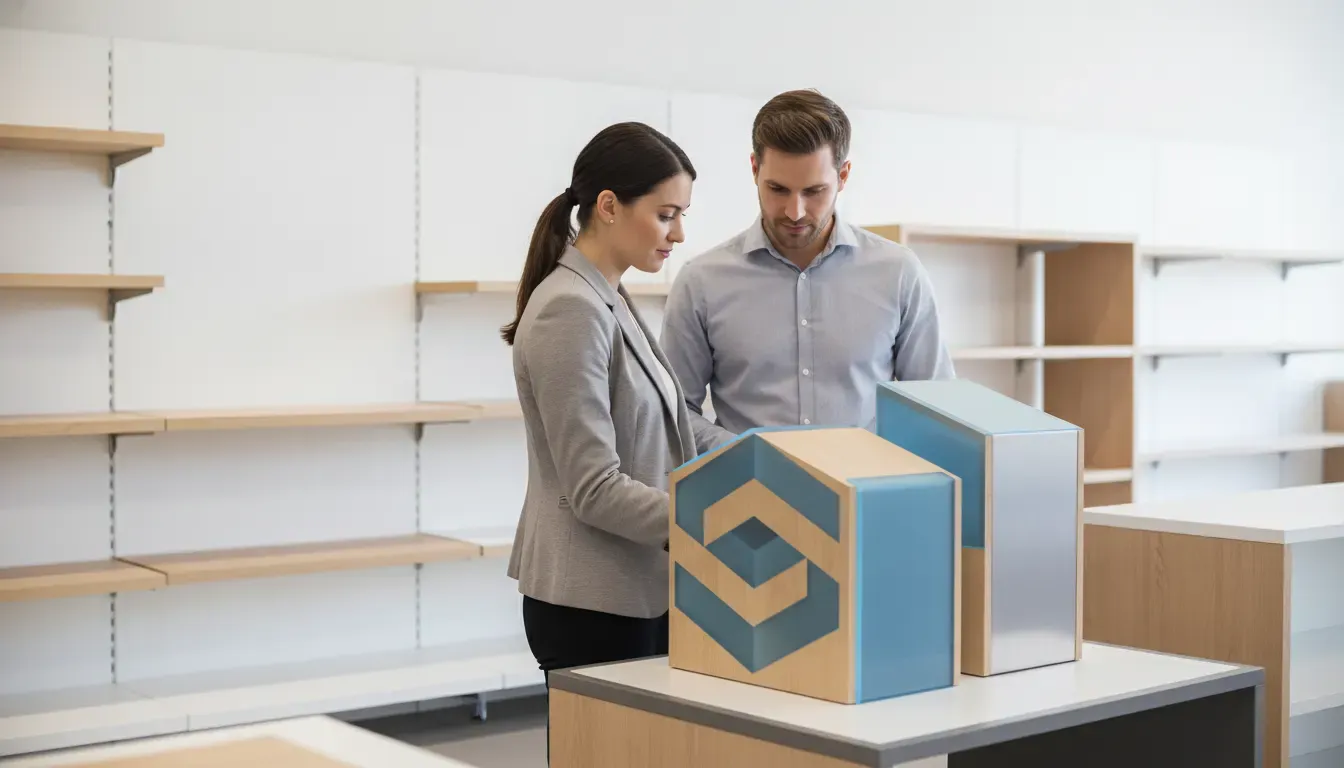


How much does a point of purchase display cost? There is no responsible single price for every POP program. A countertop unit for a short promotion, a permanent floor display, and a coordinated rollout across many stores have different requirements and cost structures. The useful question is not only what the display costs to build. It is what the complete program must accomplish, and which choices affect the total budget.
Talk with S-CUBE Fixtures about your custom retail fixture program
This guide explains the budget factors retailers should define before requesting a quote. It covers design complexity, materials, quantity, prototyping, manufacturing, freight, installation, and program scale without pretending that an unscoped project has a fixed price. With the right inputs, procurement, store planning, and visual merchandising teams can compare quotes on the same basis and make tradeoffs deliberately.
A POP display is a merchandising tool, not a single standardized product. Its cost reflects the work required to make it perform in a particular retail environment. A small display may need a simple footprint and fast production. A permanent fixture may require engineering, durable finishes, lighting, security features, packaging, and store-level coordination.
Several variables interact:
These choices are why a low unit price is not always the lowest program cost. A display that needs replacement, special handling, or repeated store corrections can create more expense than a better-engineered option selected at the beginning.
The first cost factor is the amount of design and engineering needed to turn a merchandising goal into a production-ready fixture. A straightforward display with known dimensions and simple graphics has a different workload from a branded unit that must support products, guide shopper interaction, and fit a precise store footprint.
Before discussing materials, define the result. Will the display hold a specific product count? Does it need adjustable shelves, hooks, product security, integrated lighting, or an area for demonstrations? Should shoppers approach it from one direction or several? A clear use case prevents unnecessary features and helps a manufacturer recommend the right construction.
Custom color matching, unusual shapes, dimensional branding, concealed hardware, removable components, and modular parts can all increase design effort. So can requirements for fast replenishment, easy cleaning, safe edges, accessible product presentation, or employee restocking. These are not reasons to avoid customization. They are reasons to identify it early.
A strong brief should include product dimensions and weight, merchandising capacity, target location, footprint limits, brand standards, anticipated display life, store conditions, and the desired launch date. Photos, sketches, planograms, and examples of existing fixtures can make the early conversation more productive.
Materials influence more than appearance. They affect durability, weight, production methods, packing requirements, shipping efficiency, and how the fixture will look after repeated use. Common options include wood, metal, acrylic, glass, wire, plastics, and mixed-medium construction.
Wood and laminate can create a substantial branded presence. Metal supports durable structures, shelves, frames, and hardware. Acrylic can provide clean product visibility and formed details. Glass may be appropriate when presentation and security are important. Corrugated construction can suit a limited campaign or a lightweight temporary display. The best choice depends on the merchandising job, expected service life, handling, and finish standards.
Paint, powder coating, laminates, stains, edge treatments, custom color matching, textures, and specialty surfaces each add requirements. A finish that looks simple may require additional preparation, a tighter quality-control process, or a specific production method. Ask whether the quoted finish includes samples, approval standards, and acceptable variation across the run.
Large or delicate displays may require protective packaging, knock-down construction, reinforced corners, or pre-assembly. Those choices affect both manufacturing labor and freight. A design team that considers the route from factory to store can often reduce damage risk and make installation easier without weakening the customer-facing result.
Quantity is one of the most important inputs in a point-of-purchase display quote, but it should not be viewed only as a unit-price lever. The number of displays affects material purchasing, setup, production scheduling, packaging, freight planning, quality control, warehousing, and replenishment.
A single display or small pilot can carry a larger share of design, engineering, setup, and prototype work. That does not make a pilot wasteful. It can be a useful way to validate sightlines, product capacity, assembly, shopper interaction, and store feedback before a broader commitment.
A limited deployment may support a campaign, a seasonal test, a regional chain, or a department refresh. The manufacturer can help determine which components should remain custom and which can be standardized. Repeatable parts and shared specifications can make later expansion easier.
At scale, the budget must include more than production. Retailers should plan for version control, store lists, delivery waves, inventory staging, replacement parts, packaging standards, and quality checks. A program with several fixture variations may need a clear SKU structure and a release schedule so every store receives the right configuration.
Ask for quote assumptions that show what changes if the quantity, delivery schedule, or configuration changes. This helps teams compare a pilot decision with a rollout decision instead of treating them as unrelated purchases.
Prototyping is a budget factor, but it is also a risk-control step. A prototype can reveal that products do not fit as expected, a shelf is difficult to replenish, a display is unstable, or a finish looks different under store lighting. Finding those issues before production is usually more useful than discovering them after units reach multiple locations.
Not every project needs the same prototype path. Some programs may use drawings and renderings first, while others benefit from a functional sample. Define what the prototype must prove, who approves it, how revisions are handled, and whether the approved sample becomes the production reference.
Manufacturing decisions connect design intent to program economics. Domestic production, international production, or a hybrid approach may be appropriate depending on timing, volume, complexity, quality requirements, and logistics.
Domestic manufacturing can support quick-turn needs, rapid modifications, and shorter transportation paths. International production may support larger quantities and cost optimization when the schedule allows for production and import planning. A hybrid approach can pair domestic prototyping with international production when the project benefits from both speed and scale.
The right comparison is not simply domestic versus overseas unit cost. Consider lead time, customs and import management, inspection, packaging, container utilization, inventory, delivery windows, and the consequences of a late or inconsistent shipment.
Value engineering looks for ways to meet the same merchandising and brand requirements with a more efficient design. That might involve material substitutions, fewer parts, simplified assembly, modular components, a different finish, or a packaging change. The goal is not to remove value. It is to direct spending toward the features shoppers and store teams actually need.
S-CUBE supports value engineering as part of its design and manufacturing process. Its approach can evaluate material choices, manufacturing methods, assembly, and logistics together, rather than optimizing one line item while increasing another.
Freight is easy to underestimate when a quote discussion focuses on the display itself. The delivered program may require protective packaging, palletization, less-than-truckload or full-truckload planning, import handling, storage, scheduled releases, or direct-to-store delivery.
For a multi-location rollout, delivery sequencing can matter as much as transportation distance. Aligning shipment waves with store readiness can reduce storage pressure and prevent fixtures from arriving before the teams that need to install them.
Review S-CUBE logistics and distribution support for retail programs
Installation may be handled by store teams, a field service partner, a fixture supplier, or a coordinated combination. The budget should state which party is responsible for assembly, placement, anchoring, lighting connections, product loading, debris removal, and sign-off.
Tool requirements, part counts, adjustment points, hardware labeling, instructions, and packaging sequence all affect store labor. A display that arrives ready to assemble may still be difficult to deploy if instructions are unclear or components are not organized for each location.
Store lists, delivery windows, installation dates, site conditions, local contacts, and exception handling should be visible before release. If each store has a different assortment or footprint, the plan should identify those variations. S-CUBE project management and customer service teams coordinate details across the project lifecycle, helping retailers manage execution beyond the factory.
A point-of-purchase display budget should distinguish a one-off display from a repeatable program. A one-off project may prioritize speed, experimentation, or a special store. A multi-store program prioritizes consistency, replenishment, delivery control, and the ability to repeat the solution without redesigning it for every location.
| Budget area | One-off or pilot | Multi-store program |
|---|---|---|
| Design | May carry a larger share of setup and revision work | Can spread approved standards across repeat units |
| Production | Short-run setup and limited purchasing options | Planned scheduling, repeatability, and volume coordination |
| Logistics | One destination or a small number of shipments | Phased delivery, staging, storage, and store-level routing |
| Risk control | Learn from a pilot before expanding | Version control, inspections, replacements, and rollout governance |
Scale does not automatically make every display less expensive. It changes the mix of work and increases the impact of decisions. Standardizing a core platform while allowing controlled variations can help preserve brand flexibility without creating a separate design problem for every store.
Plan your custom retail fixture program with S-CUBE Fixtures
A useful request for proposal gives suppliers enough information to price the same project. Include:
Ask the supplier to separate major cost drivers instead of presenting one unexplained total. You should be able to see how design, prototype work, production, packaging, freight, warehousing, installation, and project management are treated. Also ask which assumptions would change the quote so your team knows what to protect during revisions.
Start with the features that affect merchandising performance, safety, durability, and repeatability. Then look for savings that do not undermine the display's purpose. Possible levers include simplifying nonessential details, using a more efficient material, reducing part count, designing for flat or knock-down shipping, standardizing components, adjusting the finish, or phasing the rollout.
Do not cut quality control, product fit, packaging protection, or installation clarity simply because they appear after manufacturing in the budget. A lower initial cost can be offset by damage, rework, store labor, or inconsistent brand presentation. The most useful budget conversation identifies the tradeoff before approval.
Request a custom fixture discussion with S-CUBE Fixtures
The cost depends on the display type, dimensions, materials, finish, quantity, prototype needs, manufacturing method, packaging, freight, installation, and rollout scope. A responsible quote requires those details. S-CUBE does not publish a universal price because custom displays are scoped to the retailer's products, stores, schedule, and program requirements.
A quote may address design and engineering, prototype work, materials, finishes, production, packaging, quality control, freight, warehousing, project management, and installation. Confirm each inclusion and exclusion in writing because suppliers structure proposals differently.
Not necessarily. A one-off display may avoid broad logistics, but it can carry more setup and prototype work per unit. A multi-store program can support repeatability and coordinated purchasing, while adding delivery, storage, version-control, and installation requirements. Compare total program scope, not only unit price.
Use value engineering early. Review materials, part count, assembly, packaging, shipping configuration, finish requirements, and standardization opportunities before the design is finalized. The best savings preserve the display's merchandising job and reduce avoidable complexity.
Provide the display objective, product dimensions and weight, capacity, footprint, materials or finish preferences, store count, locations, rollout timing, prototype expectations, shipping requirements, installation plan, and brand standards. Drawings, photos, planograms, and store constraints are also useful.
Yes. S-CUBE provides design, engineering, prototyping, project management, manufacturing, quality control, logistics, distribution, warehousing, and rollout support for custom retail fixture programs. The appropriate scope depends on the project and the retailer's internal capabilities.
Point-of-purchase display cost becomes easier to control when the quote reflects the complete program. Define the merchandising goal, separate one-time and repeatable work, test important assumptions with a prototype, and review delivered cost through installation. For a custom display program built around scale, consistency, and practical execution, connect with S-CUBE Fixtures.
Subscribe for expert insights on fixture design, materials, and modern retail environments.