


A useful retail fixture cost comparison looks beyond the quoted unit price. Design work, materials, freight, store labor, maintenance, replacement, and location variation can change the total program cost. The best option depends on what each fixture must do, how consistent it needs to be, and how the program may change.
Explore custom retail fixture solutions
Compare the full set of costs and requirements across a fixture’s lifecycle, not just the first invoice. A low-priced unit can require modifications, extra assembly, or early replacement. A higher initial investment may be sensible if it can be repeated across locations or adjusted as assortments and layouts change. Treat both as hypotheses to test against the project scope.
Begin with a shared baseline: fixture quantities, store count, dimensions, product load, presentation needs, finish, delivery points, installation plan, and expected use period. Separate confirmed figures from assumptions. A supplier quote may cover fabrication but not freight, receiving, storage, assembly, or installation. Those costs do not disappear because they are outside the quote.
For a multi-location program, note how many store formats exist and which locations need variants. A prototype that fits one floor plan may need adjustment elsewhere. Record whether the program calls for one standard configuration or a controlled family of versions. This avoids comparing one option priced for a single site with another designed around a full rollout.
The labels describe different balances of specification, availability, and adaptability. They do not predict final economics on their own. A stock fixture may need accessories or modifications, while a custom design may be repeated across many locations. Compare the actual configuration, services, and cost boundaries.
| Approach | Design and materials | Delivery and installation | Maintenance and replacement | Useful decision question |
|---|---|---|---|---|
| Custom | Defined for a specific brand, product, and space; requirements and finish are specified for the program. | Production and coordinated delivery are planned; confirm assembly and installation inclusions. | Repeat orders rely on retaining approved drawings, finishes, and part details. | Can a standard format meet the required fit and presentation? |
| Semi-custom | Starts with a base design and adjusts selected dimensions, finishes, or components. | Confirm which adaptations affect packing, schedule, and shipment sequence. | Shared parts may help, but approved variants and availability need tracking. | Can a few defined changes close the gap to the need? |
| Stock | Uses an existing configuration and available options. | Availability, shipping terms, and store assembly requirements vary. | Like-for-like replacements can depend on continued availability or compatibility. | Is the existing format suitable without costly alteration? |
| Modular | Uses repeatable components that can be rearranged or expanded. | Component count, packing, handling, and in-store configuration affect execution. | Individual parts may be replaced; verify system compatibility and continuity. | Will the program need to serve changing assortments or layouts? |
These approaches can overlap. A modular system may use a custom finish, and a semi-custom fixture may use standard components. Ask for a bill of materials or scope breakdown that identifies what is common, what is unique, and which choices are still open.
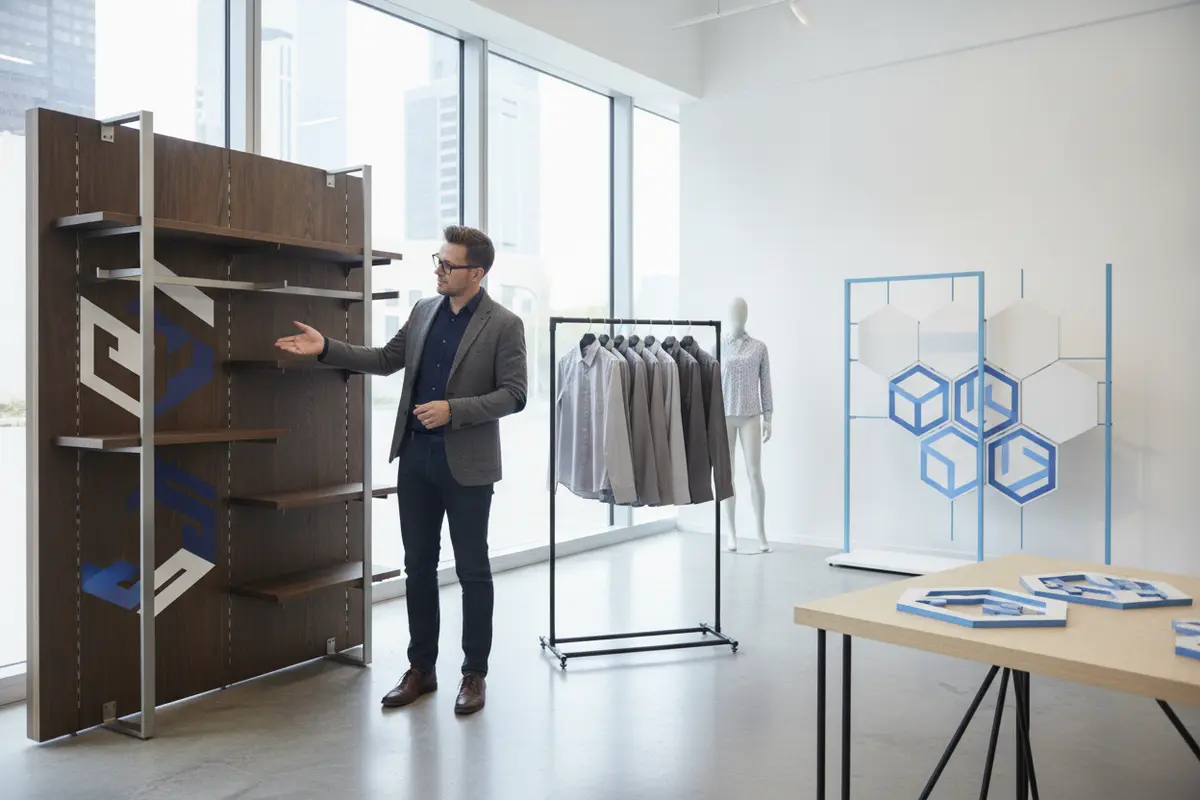
Include the work needed to turn a brief into a buildable, repeatable design. Ask whether drawings, engineering, samples, or prototypes are included and how many revision rounds the quoted scope covers. Clarify who approves the specification and how post-approval changes are handled. For a rollout, keep the approved drawings and configuration notes with the quote so later orders can be compared to the same baseline.
Design cost should be considered alongside risk of mismatch. If the fixture does not fit the product or store conditions, later modifications can consume time and budget. A useful brief specifies dimensions, product presentation, quantities, finishes, store conditions, and any location variants before supplier options are compared.
Compare material and finish requirements against actual use, not appearance alone. A fixture in a frequently handled area has different exposure than a short-term display. Describe product loads, cleaning expectations, handling, and where the unit will be placed. Avoid assuming that visually similar fixtures have the same maintenance needs or useful life.
Retail product examples can help teams describe functions: acrylic display risers illustrate elevation for merchandise, while retail shelving serves a different display role. These examples are not project specifications; they can help stakeholders make a requirement concrete before quotes are requested.
Freight depends on packaging, shipment size, delivery destinations, and scheduling. A fixture shipped in components may require more handling or assembly than a configured unit. For a multi-store rollout, specify whether shipments go to a warehouse or directly to stores, how deliveries are sequenced, and who receives and inspects them.
Separate installation from product cost. Identify who assembles, places, and secures each fixture, what conditions must be ready at each site, and how delays or missed deliveries are handled. Internal store labor is still part of the program effort even if no outside installation invoice is issued. For retail fixture programs, the U.S. Occupational Safety and Health Administration provides general workplace safety guidance at OSHA’s worker safety resources; use applicable workplace procedures when planning handling and assembly tasks.
Estimate the work to clean, repair, reconfigure, and replace components over the intended program period. Ask how parts are identified, whether future orders can match the approved design, and what happens if a component is discontinued. Modular components may allow partial replacement, but only when compatible parts remain available and teams can configure them correctly.
Consider likely changes in assortment and store layout. An adaptable fixture may reduce the need to replace a complete display, while a highly specific design may be a better fit for a stable use. Neither outcome is automatic. Compare the expected frequency and scale of change, and state what would trigger a new configuration.
Use the same quantities, delivery assumptions, and lifecycle period for every option. Gather supplier quotes where possible and mark estimates as estimates. A worksheet can organize the comparison into five groups:
For every line, note its source, owner, and confidence level. Do not compare one option’s delivered cost with another option’s product-only price. If freight or installation is unknown, show it as an open item. Do not enter zero simply to complete the spreadsheet.
A simple worked structure can make gaps visible without pretending to know prices. Suppose a retailer is comparing a stock rack with a semi-custom version for several store formats. List the same rack count for each format, then add the quoted unit price, any format-specific parts, delivery to the same destinations, store assembly hours, and a replacement assumption. If the stock option needs adjustments in many stores, record those as a separate line. If the semi-custom option shares components, record the common parts and any variant costs separately. The comparison is useful even before every figure is known because it shows which assumptions need confirmation.
Then test at least three cases: a limited pilot, the planned full rollout, and a later replacement or reconfiguration. Record what changes in each case. A pilot may favor ready availability; a larger rollout may put more weight on repeatability and delivery coordination. A future change may expose the cost of replacing a whole unit rather than a component. Treat these as scenarios, not predictions.
A lower-priced fixture can require added modifications, accessories, or store labor before it meets the need. If each location adapts it independently, execution may take more coordination and produce different results. An available model may also be difficult to match later if its configuration changes. The comparison should capture the labor and continuity implications, not assume them away.
Another common issue is unlike scope. A quote for one store may not include the packaging, staging, and scheduling needed for a chain rollout. A custom option should not be assumed to be economical simply because it can be repeated. Confirm the production quantities, site differences, delivery terms, and replacement plan before drawing a conclusion.
Before deciding, check the following:
For a small test or limited requirement, a stock fixture may be practical when the specification is straightforward and the delivery scope fits. A pilot can test whether the display function and store process work as expected. Before using a pilot quote as the rollout baseline, confirm that the same model, terms, and availability apply at higher quantities.
For a regional or national program, consistency and repeatability deserve closer review. Compare how each approach handles multiple locations, different floor plans, staged deliveries, and replenishment. Custom or semi-custom configurations can be assessed against defined program requirements; modular systems may fit when a planned component set must serve different layouts. The appropriate choice depends on the quote and conditions, not a universal rule.
Assign an owner to maintain the specification and a process for approving exceptions. Keep configuration, finish selections, delivery assumptions, and assembly instructions together. This gives buyers and store teams a shared reference when the program expands or needs replacement units.
Ask for a quote that separates the fixture from related services and states its assumptions. Include quantities by location, approved variants, materials and finishes, packaging, destinations, schedule, and any assembly or installation scope. Ask how changes are priced and how repeat orders will refer to the approved version.
Use concrete examples to describe functional needs, such as countertop display cubes for compact product presentation. For a custom program, pair such examples with the actual dimensions, use, quantity, finish, and delivery plan. S-CUBE Fixtures describes its work as spanning design, engineering, manufacturing, logistics, and installation support for multi-location environments; confirm the scope for any specific project directly.
Discuss your retail fixture program
No. Initial price depends on the design, quantity, materials, and quoted scope. Compare delivery, store labor, fit, maintenance, and replacement before deciding.
Modular systems use components that can be configured or rearranged. They may suit changing layouts, but confirm compatibility, parts continuity, and the work required to reconfigure them.
Use consistent quantities and delivery assumptions. Include location variants, freight, receiving, installation, replacement, and change management, and show unknowns as open items.
Ask each supplier to quote the same requirements and separate product, logistics, and execution scope. Confirm quantities, materials, finishes, delivery points, schedule, and how revisions and repeat orders are handled.
A useful retail fixture cost comparison makes assumptions visible and measures each option against the work it must perform. With the scope aligned, teams can choose based on store needs and the full program plan.