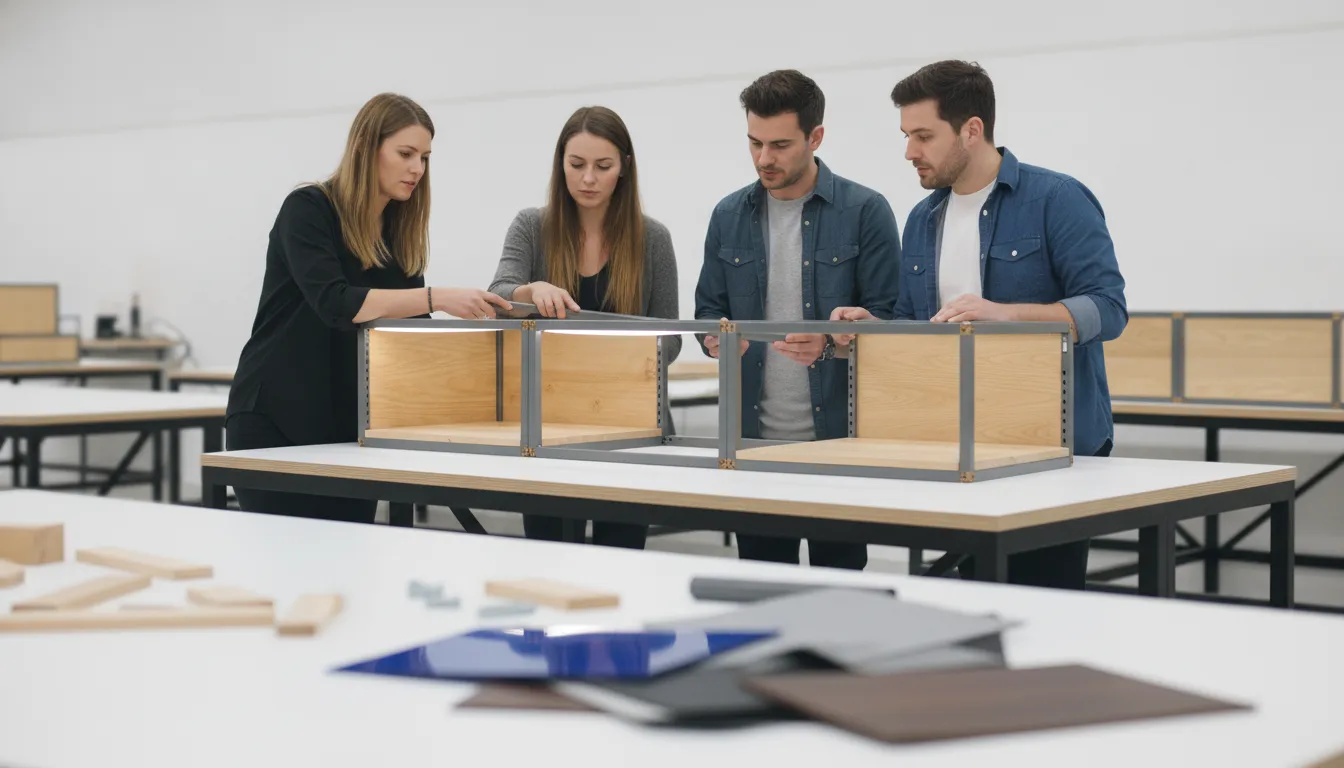


Moving a fixture program across multiple stores is not simply a matter of repeating one approved design. The buyer must turn a retail objective into a clear set of decisions that design, engineering, manufacturing, logistics, and store teams can execute consistently.
Discuss your custom retail fixture program with S-CUBE Fixtures.
Effective custom retail fixture design connects the product, store environment, shopper behavior, brand requirements, and rollout plan before production begins. A disciplined process moves from consultation and goal definition through concepts, drawings, materials, prototypes, approvals, quality checks, and store-by-store delivery.
That sequence gives every stakeholder a defined point to contribute and approve, while preserving a common fixture standard across locations. It also makes room for differences in footprint, product mix, installation timing, and local execution without allowing each store to become a separate project. The process starts by identifying what the fixture program must accomplish and which requirements cannot be compromised.
Multi-location fixture work is not simply a larger version of a single-store design exercise. The program must create a repeatable fixture system while accounting for the practical differences between locations. That means the design team and buyer need a shared framework for what stays consistent, what can change, and how each decision will move into production.
The work typically starts with consultation and goal definition. Buyers should align the project team around the merchandise, brand experience, store environment, shopper behavior, schedule, materials, expectations, and budget. Product category matters because size, weight, and fragility influence the fixture. The environment matters because available floor space, lighting, and traffic flow vary by store. Shopper behavior matters because an impulse purchase may need a different presentation from a considered or assisted sale.
From there, the workflow moves through solution configuration, design review, prototype refinement, approval, production, and rollout support. Those stages are not a substitute for a project-specific plan, but they give stakeholders clear checkpoints: define the requirements. Review the proposed solution, confirm the approved specifications, and coordinate execution.
Multi-location control becomes especially important after approval. Store-by-store scheduling, phased rollouts, kitting or staging, direct-to-store shipping, and delivery aligned with installation help translate one approved fixture program into location-level work. Each store can have its own sequence or site condition without creating a new design process from scratch.
The buyer-facing deliverable is therefore more than an attractive concept. It is a controlled path from product and environment inputs to approved fixtures, repeatable documentation, and a rollout schedule that the broader team can execute.
A useful discovery brief turns an initial idea into decisions that a design and engineering team can act on. Start with the retail objective, the products the fixture must present, how shoppers should interact with them, and what store teams must replenish, maintain, or reconfigure. Include inspiration photos or rough ideas where available, but pair them with operational requirements rather than treating visual references as a complete specification.
Organize the brief around the conditions that will shape custom retail fixture design:
Ask decision questions early: Which elements need to repeat across locations? Where is flexibility more valuable than standardization? What must be confirmed before drawings begin?
S-CUBE lists concept development, 3D renderings, CAD design, technical drawings, and material and finish recommendations among its design services. Buyers can review the custom fixture design and prototyping process to understand how those inputs can become reviewable design information.
The brief does not need to predict every engineering answer. It should make the goals, constraints, owners, and approval path visible. That gives the design team a reliable starting point and gives the buyer a clear basis for comparing concepts before the program moves toward prototyping and production.
Once the brief is approved, the design team turns buyer requirements into reviewable options rather than moving straight to a single finished fixture. Concept development can begin with inspiration photos or rough ideas, then progress through 3D renderings, CAD design, technical drawings, and material and finish recommendations. For a multi-location program, each review should answer a practical question: what is being approved, where will it be used, and which decisions must remain consistent across stores?
Concept options should show how the fixture supports the product category, store environment, and expected shopping behavior. Product size, weight, and fragility may influence the form, while the available footprint, traffic flow, and surrounding merchandising affect placement and access. A rendering helps stakeholders review the overall presentation. CAD and technical drawings move the discussion toward buildable details, interfaces, and repeatable requirements.
For the buyer, the useful record is not only the preferred image. It is the approved direction, the rejected alternatives, and the assumptions behind the choice. That record gives procurement, visual merchandising, construction, and store teams a common reference as the program advances. The related retail fixture engineering work connects the visual intent to production-ready decisions.
Material selection can include wood, metal, acrylic, glass, wire, plastic, or mixed-media combinations. The decision should reflect the brand specification and the fixture's role, not simply a preferred sample. Buyers should review finish appearance, how components will be assembled, how the selected materials fit the store environment. And whether the same finish can be identified and reproduced across locations. Lighting also belongs in this review. It can highlight featured merchandise and help shoppers see accurate color, so lighting direction and color appearance should be considered alongside the finish palette.
Value engineering is a structured review of cost drivers, alternatives, manufacturing methods, assembly, and logistics. It may change a component, simplify assembly, or adjust how the fixture is packed and shipped. Each proposed change should be documented with its effect on appearance, function, installation, replenishment, and rollout consistency. Approving the lowest-cost option without recording those tradeoffs can create problems later. The stronger decision is the one that protects the customer-facing intent while making the design practical to produce, handle, and repeat across the program.
A rendering can confirm the direction, but a physical prototype reveals what a screen cannot. In custom retail fixture design, the prototype gives the buyer a controlled opportunity to evaluate form, fit, and function before the design reaches production. It turns an abstract approval into a review of the actual customer-facing object.
Review the sample against the conditions it must handle in store:
These checks should create a defined feedback loop, not an informal request for general impressions. Bring the relevant stakeholders into the review, record each comment, identify whether it requires a design change, and assign an owner for the response. The next iteration should be evaluated against that record so the team can distinguish an approved revision from an unresolved preference.
S-CUBE describes functional prototypes as a way to support form, fit, and function evaluation, with designs refined from feedback before pre-production samples are presented for approval. A physical sample before production is also a useful control because it lets the buyer verify the intended result before committing the broader rollout. The process is not automatic: the buyer should define who can approve the sample, what evidence they need, and what conditions must be met before signoff.
Keep the final decision visible in the project record. It should identify the reviewed version, open exceptions, required corrections, and the person authorized to release the design. For a deeper look at this stage, see display fixture prototyping. A clear signoff record gives production and store teams a shared reference, while preserving a practical basis for resolving questions during rollout.
A production handoff should leave the factory with one clear, approved source of truth. It is more than a final rendering. The package should explain what is being built, how it should be built, how it will be checked, and which version the team is authorized to use.
Start with the approved design record. Include dimensioned drawings, relevant views, finish callouts, component details, assembly information, packaging requirements, and any installation notes needed for the intended store environment. Specifications should identify the approved materials and finishes without leaving manufacturers to interpret a visual reference. If a detail affects fit, appearance, shopper access, or repeatability across locations, document it rather than relying on an informal conversation.
The work order and manufacturing instructions should match the approved drawings. They should identify the current revision, required operations, inspection points, and the records that operators or inspectors must complete. A useful neutral reference is NASA's manufacturing documentation standard, which describes documentation such as instructions, drawings, specifications, work orders, and process records. This is a documentation principle, not a retail certification or a requirement that every fixture program follow NASA standards.
Quality control belongs in the production package, not as an afterthought at shipping. Define checks for dimensions, assembly, materials and finishes, and documentation. Include factory-level and pre-shipment inspection records so the project team can verify what was inspected and what result was accepted. This creates a practical chain from design intent to finished fixture.
Change control is equally important. Record approved revisions, superseded files, open decisions, and the person or team authorized to approve changes. Before release, confirm that the production set, work order, inspection plan, assembly instructions, and packaging details all reference the same revision. S-CUBE's fixture manufacturing process can help buyers evaluate how these production details fit together. A disciplined handoff reduces interpretation, protects consistency, and gives every location the same approved starting point.
Production strategy should follow the rollout problem, not a default sourcing preference. Domestic production may suit quick-turn work or a pilot that needs close coordination. International production may be considered for larger-volume programs where the operating model and schedule support it. A hybrid approach can pair domestic prototyping with overseas production, giving the team an opportunity to refine the fixture before a broader run. These are planning options, not guaranteed outcomes. The right path depends on volume, approval readiness, product complexity, logistics, and the required opening sequence.
| Production path. | Potential fit. | Buyer checkpoint. |
|---|---|---|
| Domestic. | Quick-turn work or pilot coordination. | Confirm capacity and opening sequence. |
| International. | Larger-volume programs. | Confirm readiness and receiving plan. |
| Hybrid. | Domestic prototype, broader production. | Carry revisions into the production package. |
Once the production route is selected, convert the rollout into a store-level schedule. Group locations by opening date, fixture configuration, quantity, and installation requirements. That schedule should identify what is released, inspected, packed, and shipped for each store rather than treating the entire program as one shipment. Kitting can keep the parts and hardware for a specific location together. Staging can create a controlled checkpoint before delivery, especially when several fixture types or product categories must arrive in a coordinated sequence.
Direct-to-store shipping can reduce unnecessary handling when the destination, receiving process, and installation plan are confirmed in advance. Delivery timing should be aligned with the installation window, not simply with the date production finishes. A shipment that arrives too early can create storage and inventory-control problems. One that arrives too late can disrupt contractors, store teams, and the opening plan. Confirm receiving contacts, access conditions, package identification, and the handoff owner for each location before release.
For a program that needs coordinated production, logistics, and installation support, review S-CUBE's retail fixture rollout services. The objective is a clear handoff from approved custom retail fixture design into repeatable execution. Location-level control helps manage real-world differences without losing the consistency of the core program.
Before releasing a fixture package, confirm that the approved design can be executed consistently at every location, not just that the concept looks right in a presentation. A practical final review should cover:
A disciplined release gate turns prototype-to-production process into a repeatable handoff, reducing avoidable confusion as the program moves from one store to many.
Provide product dimensions and handling requirements, store footprints, shopper-flow considerations, brand guidelines, expected quantities, rollout locations, schedule, budget, and the stakeholders who will approve decisions. This gives the design team a usable brief instead of disconnected preferences.
Yes. Establish a repeatable core specification for brand-critical elements, then identify which components can change by location. Store-specific footprints, product assortments, or installation conditions can be documented as controlled variations rather than separate designs.
A functional prototype lets the team evaluate form, fit, and function in a tangible way. Feedback can then be incorporated before a pre-production sample is approved, reducing the risk that an unresolved design issue reaches multiple stores.
Approve the current drawings, dimensions, materials, finishes, assembly approach, packaging or kitting requirements, store variations, and inspection expectations. Record the approval version and route later changes through a defined change-control process.
Use a store-by-store schedule that connects production, kitting or staging, direct-to-store shipping, and installation timing. Track changes and pilot-store learning so later phases use updated instructions rather than repeating the same issue.
A clear process helps align design decisions, approvals, production details, and store-by-store execution before work moves forward. S-CUBE Fixtures can help your team discuss the requirements for a coordinated multi-location program. Contact us about custom retail fixtures to review your design and rollout needs.
Subscribe for expert insights on fixture design, materials, and modern retail environments.