


Retail fixture program decision rights decide who may approve a fixture change before it reaches the shop floor. A comment from a store manager, a brand designer, or a construction lead is useful. It is not the same as permission to change a drawing, a finish, or a price. When those roles are not named, the manufacturer receives two directions and has to guess which one controls the work.
S-CUBE Fixtures builds custom fixture programs for multi-location retailers, from a pilot store through rollouts that can cover hundreds of locations. A dedicated US-based project manager is assigned to every program. That person can keep the timeline moving only when your team has already named who prepares each decision, who must be consulted, and who can approve it.
See how a custom fixture program is scoped
A custom fixture program asks for decisions about merchandise, appearance, dimensions, materials, price, site conditions, and delivery. Those decisions touch each other. A wider shelf can change the look of a run, the cost of the material, and whether the unit still clears a column. One person rarely owns all of that.
The stall usually looks small at first. Someone on a review call says the color is close enough. Someone else emails a different Pantone the next morning. Neither note says whether manufacturing is authorized. The shop then waits, or it builds the wrong version. Both outcomes cost a rollout calendar.
A responsibility assignment matrix, often called a RACI, names four roles for each deliverable: Responsible, Accountable, Consulted, and Informed. The Accountable role is the one person who signs off. That rule travels well into a fixture program. Many people can be consulted. One named owner records the answer the vendor is allowed to follow.
S-CUBE is a second-generation, family-owned division of Specialty Store Services, working from a Chicago-area facility in Des Plaines since 1987. The headquarters at 454 Jarvis Avenue is a large office and distribution operation near O'Hare, and programs ship nationwide. Fixtures are built to be repeated, not invented store by store. Decision rights are what keep that repetition honest when a new comment arrives late in the week.
Lead times for a custom program often run six to ten weeks after design approval, with domestic prototyping and a choice of domestic or overseas production. A week lost to "who approved this" is a week you cannot give back to the stores. Naming the owner before review is cheaper than stopping a line.
Create the register before drawings go out for markup. It is an operating tool for the program, not a substitute for the contract. It should name, for each decision, who prepares the information, who must be consulted, who can approve the result, and who records it.
Keep the list short enough that a busy buyer will use it. Six subjects cover most fixture programs:
Name one primary owner for each subject. Other people can supply evidence. If two teams must both sign, write that sequence down. Do not leave the manufacturer to infer that a yes from design is also a yes from store planning and from procurement.
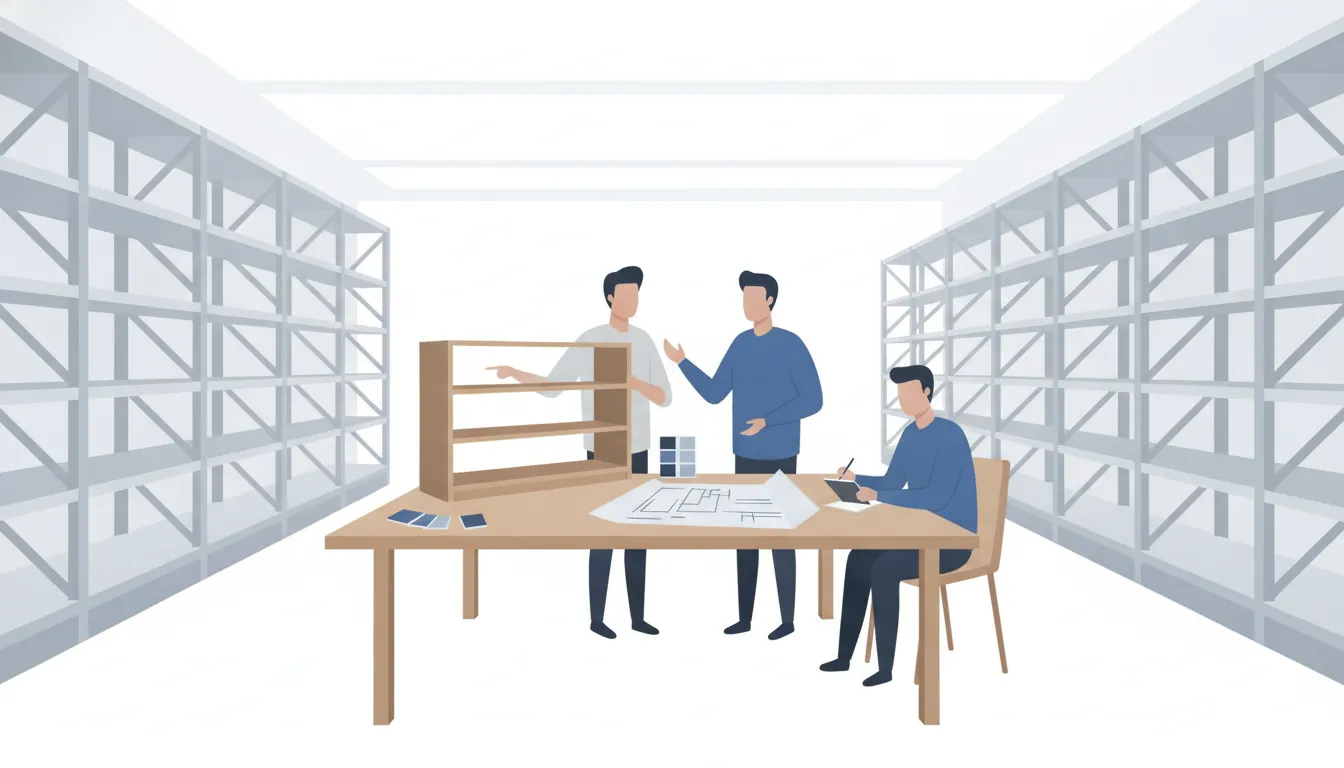
Some decisions cross subjects. A different door on a showcase can change the look, the way an associate reaches product, and the price. Name a lead owner who gathers those inputs and confirms one combined answer. The person who first suggested the change is not automatically that lead.
Store teams notice real problems. An associate may find a drawer that is awkward to reach. A visual merchandiser may flag a finish that fights the brand book. A site lead may report a column the drawing missed. Those notes deserve a response. They do not, by themselves, change production.
Write down how a comment becomes a decision. The subject owner reviews it, consults the people the register names, and returns one disposition: accepted, rejected, revised, deferred, or waiting on another input. Send that disposition to the manufacturer as a single instruction.
Label the scope of the yes. Agreement on a rendering is not agreement on dimensions, construction, or cost. A note that a concept was "discussed" is not a release to manufacture. Meeting minutes should say which decision was made and which decisions were only talked about.
This is also how you stop contradictory email chains. If brand and operations disagree, the lead owner states the conflict, compares it with the priorities the program already agreed, and records the tradeoff. The vendor should not be asked to pick a winner.
An owner cannot approve what they have not been shown. A reply of "looks good" on a perspective image can leave the critical interface open. Tie every approval to a specific document, sample, or measurement, and to the revision of that document.
Early gates need less evidence than a manufacturing release. A concept gate can compare layouts and a visual direction. A prototype gate should prove form, fit, and function against the merchandise the store will actually sell. A release gate needs closed conditions: the approved drawing revision, the finish sample, the commercial scope, and any site dimensions the design depends on.
If a fact is missing, name the gap and the person who will close it. A cabinet width that waits on a field measure should say so. Silence from a reviewer who has not answered is not approval, unless the register says that rule in plain language and the team has agreed to it.
S-CUBE's end-to-end fixture services cover design, engineering, prototyping, project management, manufacturing, and logistics. Quality checks run in the US and overseas from prototype approval through production. Those checks compare the build with the approved spec. They cannot invent the spec when two approvals disagree.
| Decision area | Who usually prepares it | Question the owner must settle | Evidence to attach |
|---|---|---|---|
| Merchandise fit | Merchandising or store operations | Which products, pack-outs, and selling method does this fixture have to hold? | Product list, pack sizes, and a sample or measured item |
| Brand appearance | Brand or visual merchandising | Which finish, color, and graphic direction is accepted? | Finish sample or brand reference, plus the rendering revision |
| Spatial arrangement | Store planning | Does the plan, clearance, and staff path work in this format? | Plan drawing with revision and adjacency notes |
| Engineering | Store planning with the manufacturer | Is the structure, hardware, and material build accepted? | Engineering drawing and prototype notes |
| Commercial scope | Procurement or the program buyer | Who can accept a change in price, quantity, or lead time? | Quote revision that shows the delta |
| Site and release | Construction or store development | Are field conditions closed, and is production released? | Site confirmation plus the release checklist |
The register says who has authority. The log says what was actually decided. Give each significant decision an identifier. Record the subject, the fixture or SKU it affects, the document revision, the outcome, the owner, and the date. Add any condition that is still open.
Link the log line to a drawing number and revision, a named finish sample, or a quote. A drawing number without a revision becomes ambiguous after the second markup. A finish approval that does not name the sample will be re-litigated when the first production piece arrives.
Do not turn the log into a transcript of every call. Summarize the result and point to the backup. The test is simple: can someone new to the program tell which instruction currently controls the work? If two open lines contradict each other, the log has not done its job yet.
On a multi-location program, that log is also how later stores stay aligned with the first. S-CUBE has managed programs with more than 120 fixture SKUs and coordinated 10 to 12 trucks into a single store. Books-A-Million is one example: new fixtures, value engineering, and staged delivery had to land as one package. A decision that lives only in one person's inbox will not survive that kind of coordination.
Value engineering belongs on the same log. S-CUBE uses it to challenge cost without dropping the approved quality level, and past programs have shown large savings once the spec was stable. A savings idea is still a comment until the commercial owner accepts the revised scope. Otherwise the shop cuts cost in a place brand or store planning never approved.
A pilot is where decision rights get tested, not where they get invented under pressure. Before the prototype is reviewed, confirm the register with the people who will still be in the job when store 40 opens. A pilot approval from a team that will not own the rollout is a courtesy, not a release.
The custom retail fixture design process moves from brief to drawings, prototype, and production handoff. Decision rights sit beside that process. They say who may accept the brief, who may sign the prototype, and who may release production. They do not replace the design steps.
After the pilot, freeze the subjects that should not drift: merchandise rules, approved finishes, and the engineering that passed in the store. Later changes still go through the same owner. A regional request to "just adjust this bay" is a comment until the subject owner records a disposition and, if cost or timing moves, the commercial owner accepts it.
For programs that span many markets, pair this register with the consistency work in national retail fixture programs. That guide covers specification and change control. This one covers who is allowed to make the change. A pilot store fixture program is the right place to prove both before you scale.
Talk through a custom fixture program
Name one Accountable owner for each subject, not one owner for the whole program. Merchandising, brand, store planning, procurement, and construction each approve different questions. A lead owner gathers cross-subject decisions and records one answer the manufacturer can follow.
No. A comment raises an issue. Approval is a recorded disposition from the owner named in the register, tied to a drawing revision, sample, or quote. "Looks good" on a rendering does not release dimensions, construction, or cost.
The lead owner states the conflict, compares the options with the priorities the program already set, and records the tradeoff. The manufacturer should receive one instruction, not both emails. Silence from a missing reviewer is not a yes unless the register says so.
Finish it before detailed drawing review, and confirm it again before the pilot. Changing owners after production starts is how contradictory directions reach the shop. If a required fact is still open, record the gap and who will close it instead of approving around it.
A dedicated project manager coordinates the program, and production is checked against the approved spec. The register tells that team which comment is allowed to change the work. Start with the contact form and name the owners on your side.
Retail fixture program decision rights are a short register, a rule that comments are not approvals, and a log tied to real revisions. Set them before the first detailed review, then use the same owners from the pilot through the rollout. S-CUBE can plan, engineer, and produce the fixtures once those owners are named.
Tell Jeff or Kevin about the program, the number of locations, and who on your side can approve merchandise, brand, space, and cost. Reach the team through the contact page.