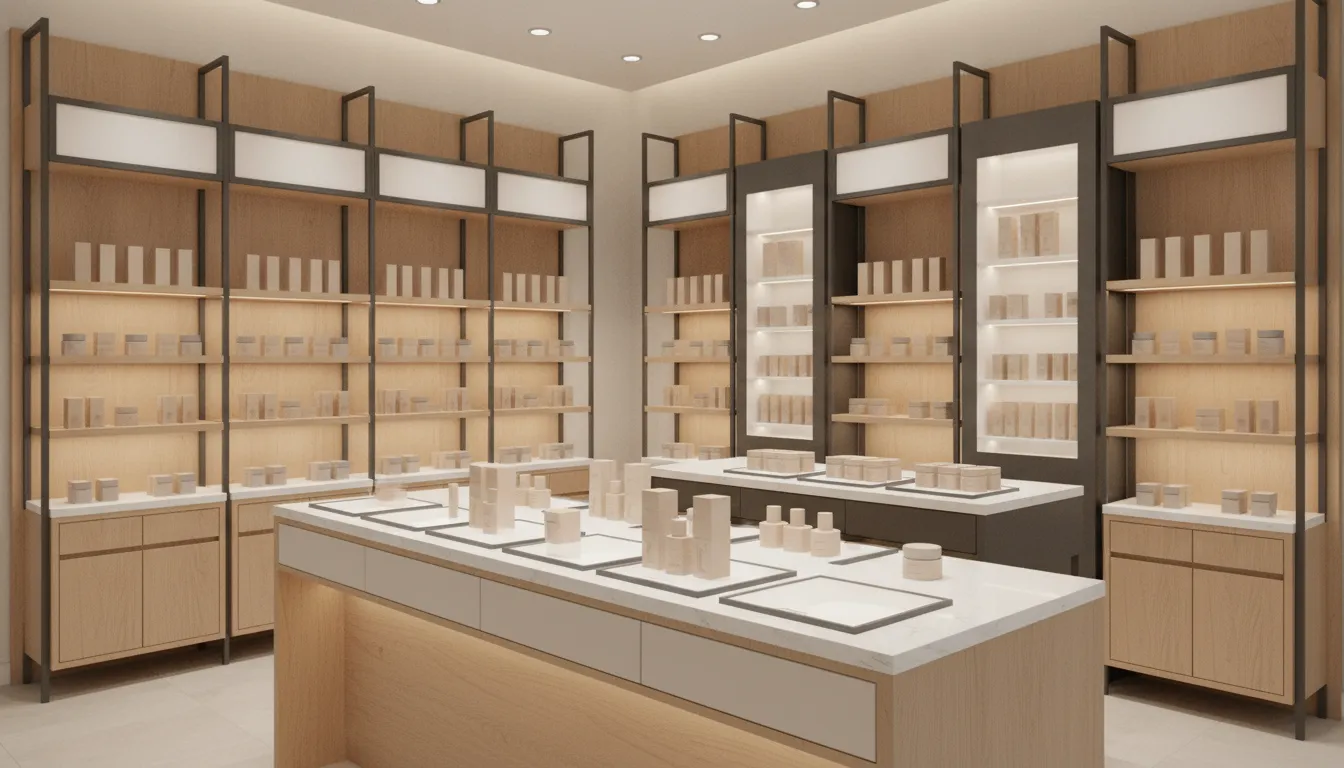


Cosmetic retail fixtures have to support more than an attractive product presentation. For a multi-store beauty program, the fixture system must organize product families, make testers easy to use, give associates a practical replenishment path, support accurate product evaluation, and remain consistent from the pilot location through the final store. That makes the buyer's brief as important as the fixture design.
Plan a custom cosmetic retail fixtures program with S-CUBE
Cosmetic retail fixtures are coordinated display systems built around the way beauty products are categorized, tested, replenished, secured, and rolled out across stores. A strong program turns those operating requirements into repeatable specifications for shelving, testers, lighting, materials, access, packaging, and installation.
This guide is for procurement leaders, store planning teams, visual merchandising executives, and brand operators buying fixtures for multiple locations. It focuses on program specifications and deployment controls, rather than repeating a general beauty-store layout guide or a case-only discussion.
Cosmetic retail fixtures should help shoppers understand the assortment while helping associates keep it accurate, clean, stocked, and ready for interaction. The best system connects merchandising, shopper experience, and store operations instead of treating the display as a decorative shell.
A useful buyer brief starts by assigning each fixture a job. A wall bay may carry a broad skincare assortment, a countertop unit may support a focused launch, and a controlled display may present premium or limited-release products. Defining those jobs first makes later decisions about dimensions, materials, lighting, and accessories more precise.
Product families should drive the fixture architecture because cosmetics vary widely in package size, display orientation, shade count, replenishment frequency, and shopper evaluation. A system designed around one package type will usually waste space or create awkward workarounds when the assortment changes.
Build an assortment matrix before requesting final drawings. For each family, record the current and expected SKU count, package dimensions, preferred orientation, facings, shelf capacity, tester requirement, security level, and planned promotional changes. Note which products need upright presentation, angled visibility, dividers, trays, drawers, or dedicated launch space.
Skincare bottles may need stable vertical storage and enough clearance for shoppers to read front and side information. Palettes and boxed color products may benefit from shallow shelves, stepped presentation, or dividers that keep shades visible. Small lip and eye products often need tighter organization and high facings, while fragrance or premium collections may call for elevated presentation and controlled access. These are specification questions, not reasons to force every family into one display format.
Beauty assortments change quickly. Leave a documented amount of flexibility for new packaging, seasonal edits, promotional sets, and product retirement. Adjustable shelves, interchangeable dividers, modular inserts, and replaceable graphic or finish elements can help a program adapt without redesigning every fixture. Flexibility should still be controlled: identify which parts are adjustable, what the approved range is, and how stores should reset the display.
Testers are part of the operating system, not an accessory added after the main fixture is complete. A tester plan should make sampling intuitive for shoppers, manageable for associates, and visually connected to the sellable product without mixing the two workflows.
Replenishment deserves the same level of attention. Define whether associates load from the front, rear, top, drawer, or removable insert. Confirm the clearance required for hands, cartons, and cleaning tools. If a fixture is attractive but slow to restock, stores may overfill it, leave gaps, or move products into unofficial locations. A practical fixture standard prevents those outcomes before production.
Cosmetics depend on visual judgment, so lighting should be specified as a product-evaluation requirement rather than a decorative feature. The brief should explain what shoppers need to see, where they will stand, and how the display should perform alongside the store's existing lighting.
Brightness alone does not prove that a cosmetic display works. A specification review should include the real package colors, the surrounding store conditions, and the way testers will be handled. For a national or regional program, approve the lighting standard with the same care given to finishes and dimensions. S-CUBE's design and engineering process can bring those requirements into the prototype and manufacturing discussion before a larger release.
Material selection should follow the fixture's job, cleaning routine, product load, security needs, and brand finish. Cosmetic programs commonly combine wood or laminate surfaces, metal structure, clear panels, acrylic components, glass, wire, or other mixed media rather than relying on one material everywhere.
| Component | Define in the brief | Why it matters at rollout |
|---|---|---|
| Shelves and dividers | Load, spacing, adjustability, facings, and insert geometry | Controls capacity and keeps product families consistent |
| Tester counter | Height, reach, cleanability, drainage or containment needs, and replacement parts | Protects daily usability and maintenance routines |
| Frames and supports | Structure, tolerances, anchoring, and service access | Reduces assembly variation and field problems |
| Clear panels or doors | Visibility, thickness, access method, edge treatment, and security | Balances product presentation with protection |
| Finishes and coatings | Color, sheen, touch points, cleaning chemistry, and approved samples | Preserves brand consistency across production lots |
Request physical finish samples and a functional prototype when the program has demanding color, access, or durability requirements. Review joints, edges, fasteners, shelf adjustments, and replaceable parts at the same time. The goal is not to choose the most expensive material. It is to choose a construction approach that performs predictably in the intended store environment and can be produced consistently at the required volume.
For multi-location buyers, document the approved materials, finish codes, tolerances, hardware, and substitution rules. If a domestic or international production route changes, the specification should make clear which details cannot change without written approval. That protects the customer experience while giving the manufacturing team a usable standard.
Ask S-CUBE to scope your cosmetic fixture specifications and rollout needs
A multi-store program needs a controlled path from discovery to field verification. The program should preserve the approved design while making documented adjustments for store footprints, product volumes, electrical conditions, installation constraints, and regional release schedules.
S-CUBE supports custom fixture programs from pilot locations through rollouts of more than 500 stores, with design, engineering, manufacturing, project management, warehousing, distribution, and quality control capabilities. The right partner should be able to explain how those functions connect, not only show a finished fixture.
A strong request for proposal gives the fixture team enough information to evaluate the full program. Include the following items before asking for a final recommendation:
When these inputs are clear, the resulting conversation can focus on tradeoffs rather than assumptions. S-CUBE's design, engineering, and prototyping services, project management and customer service, and logistics and distribution capabilities are relevant when one partner needs to coordinate the program from concept through delivery.
Plan a repeatable cosmetic fixture rollout with S-CUBE
Cosmetic retail fixtures are display systems designed around beauty product presentation, testing, replenishment, security, and brand standards. They can include wall bays, shelving, gondolas, countertop units, tester stations, display cases, and modular accessories coordinated into a repeatable store program.
Cosmetic fixtures should place testers near the products they represent, provide a cleanable and easy-to-maintain surface, separate sampling from sellable inventory, and leave associates enough access to replenish both zones. The tester standard should be tested with representative products before rollout.
The best lighting depends on the products, store environment, shopper viewing distance, and product-evaluation goals. Buyers should test representative shades and packages for glare, shadows, hot spots, and consistency, then document the approved light source, placement, controls, and rollout test.
Retailers keep fixtures consistent by approving modular standards, finish samples, drawings, bills of materials, prototype criteria, inspection points, installation instructions, and field-verification checks. Store-specific changes should be documented as controlled variations rather than informal substitutions.
A buyer should provide store information, product dimensions, assortment and tester requirements, fixture jobs by zone, lighting and finish expectations, quantities, pilot criteria, milestones, delivery waves, installation conditions, and approval responsibilities. Better inputs produce more useful drawings, prototypes, and pricing.
Schedule a conversation about your cosmetic retail fixtures program with S-CUBE
Subscribe for expert insights on fixture design, materials, and modern retail environments.