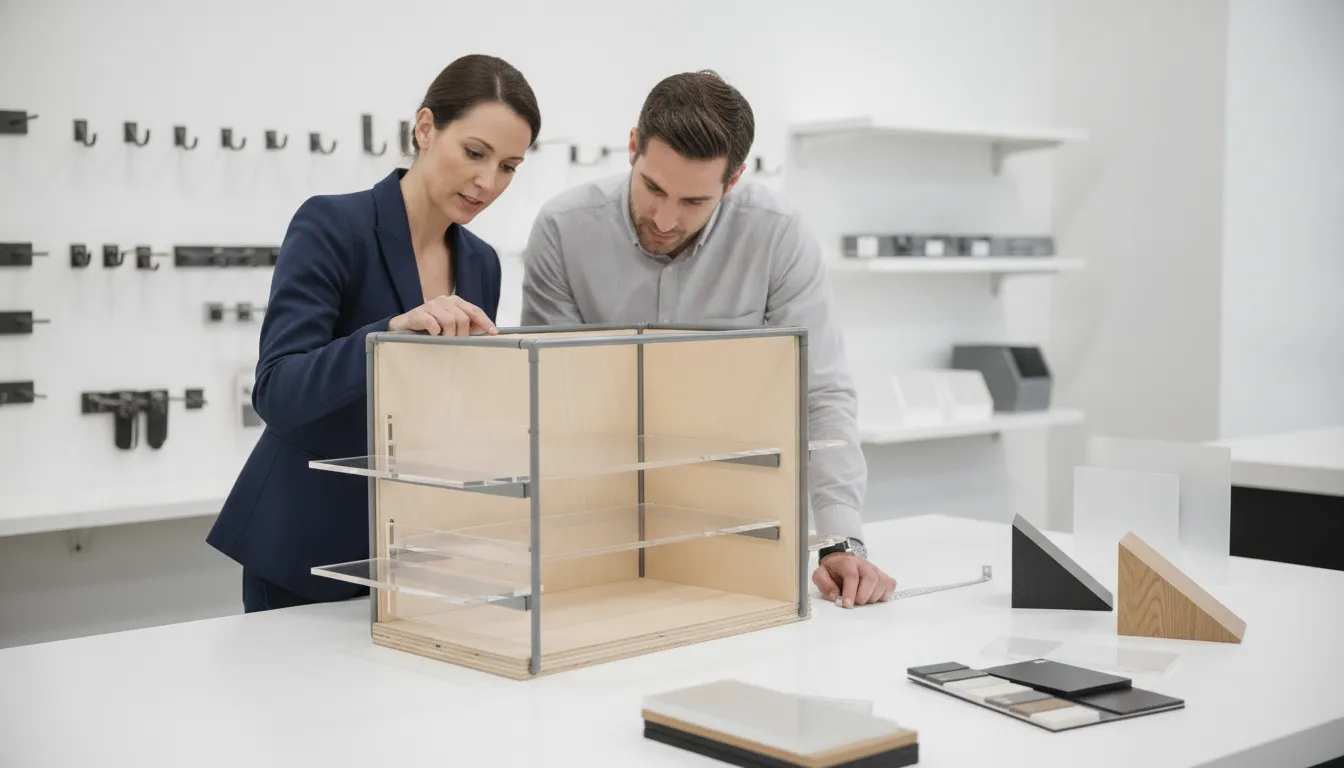


Custom fixtures become easier to manage when the buyer defines the program before asking for a quote. Store count, rollout phases, product requirements, brand standards, delivery locations, and approval owners give a fixture partner the context needed to plan accurately. Without that information, an attractive concept can still create avoidable changes, schedule risk, or installation problems.
Custom fixtures for retail stores make the most sense when a retailer needs repeatable execution across multiple locations, a brand-specific presentation, or an unusual product or workflow solution. They also help when buyers need tighter control over how fixtures move from approval through manufacturing and delivery. For simpler, speed-driven needs, a Retail Ready option may be more appropriate.
Discuss a custom retail fixture program with S-CUBE Fixtures.
The first decision is whether the program's scale, customer experience, and operating requirements justify a custom path.
Custom fixtures become worth evaluating when the retailer needs more than a standard product can provide. The decision usually depends on the relationship between brand requirements, store complexity, product presentation, and rollout scale, not on whether custom is inherently better.
Custom is a strong fit for enterprise, regional, franchise, and other multi-location programs that need a consistent experience across different footprints. A purpose-built specification can preserve key brand details while allowing controlled adjustments for each store. It also creates a clearer path for repeat orders, replacement parts, and phased openings. S-CUBE supports programs ranging from pilots to rollouts across 500+ locations and can coordinate programs involving 120+ SKUs, with final requirements confirmed during scoping.
Start a custom conversation when products have unusual dimensions, the merchandising workflow is distinctive, or a fixture must combine several functions in one coordinated unit. Custom may also make sense when finish, proportions, sightlines, or integration with an established store environment are central to the customer experience. In these cases, a standard fixture may require enough modification, compromise, or field work that it no longer offers a simple solution.
Retail Ready fixtures can be appropriate when the need is straightforward, the footprint is predictable, and rapid deployment matters more than a tailored system. Many retailers use both approaches: Retail Ready components for immediate or supporting needs, and custom elements for brand-critical areas or later rollout phases. Compare custom versus off-the-shelf fixtures by defining the locations, products, approvals, and timing before selecting a path.
Before design begins, assemble the information a fixture partner needs to understand the program. A practical buyer brief should connect merchandise, store conditions, brand requirements, and the decisions that control rollout risk.
With these inputs organized, the buyer can give the project team a clear starting point without prescribing every engineering answer. S-CUBE's retail fixture design and prototyping services can help translate the brief into reviewable concepts, drawings, and prototypes.
A quote-ready scope turns a broad retail objective into a controlled package that a supplier can price, engineer, manufacture, and deliver without filling critical gaps through guesswork. Start with the quantity plan: total units, store count, rollout waves, location matrix, and a stable SKU or BOM structure. Each line should identify the fixture or component, required quantity, approved configuration, accessories, hardware, and any store-specific variation.
Attach the information needed to understand fit and use. Include floor plans, elevations, available dimensions, site conditions, product sizes, replenishment methods, associate workflow, customer-facing requirements, and any installation constraints. Brand standards should cover artwork, graphics, colors, proportions, and other visual rules. The material and finish schedule should identify substrates, surface treatments, edge details, sheen, and approved references. Keep these decisions connected to the drawings and BOM so a change to one does not quietly invalidate another.
The package should also define the commercial and operational boundaries. State delivery locations, receiving limitations, staging or warehousing assumptions, installation ownership, target dates, approval milestones, and budget boundaries without presenting an unsupported public price. List exclusions explicitly, such as site work, electrical work, permits, graphics, or installation, but include only exclusions that are genuinely outside the planned scope. Record open questions, allowances, dependencies, and revision status. A document marked "for quote" should not be confused with an approved production release.
Finally, explain the product and workflow purpose in plain language. A fixture may need to support shelving, display racks, signage, or another merchandising function; NIST MEP describes these as examples of fixture solutions serving varied retailer needs (NIST MEP fixture case study). For help connecting requirements to drawings, prototypes, and engineering decisions, review S-CUBE's retail fixture design and prototyping services. The stronger the scope, the more useful the resulting quote and the easier it becomes to compare revisions, assumptions, and delivery risk.
A vendor handoff is ready when the buyer's intent has been converted into controlled decisions, not merely when a rendering looks attractive. Assign an owner to each decision and record the evidence that authorizes the next stage. This prevents procurement, merchandising, construction, and store teams from working from different assumptions.
| Decision. | Owner. | Approval evidence. |
|---|---|---|
| Design intent and store use. | Brand, visual merchandising, and operations. | Approved 3D visualization or concept record showing product presentation, workflow, and brand direction. |
| Dimensions, configuration, and BOM. | Store planning, engineering, and procurement. | Revision-controlled CAD drawings, location assumptions, quantities, and signed bill of materials. |
| Materials and finishes. | Brand, design, and procurement. | Named material and finish schedule with accepted physical samples or documented references. |
| Prototype or sample. | Project lead and designated cross-functional reviewers. | Review record covering form, fit, function, assembly, finish, open corrections, and authorized signoff. |
| Packaging and installation. | Logistics, construction, and store operations. | Packaging specification, assembly instructions, installation directions, receiving plan, and named site contacts. |
| Schedule and release waves. | Program manager and retailer project owner. | Agreed milestone schedule identifying design approval, production release, delivery windows, and installation sequence. |
| Change control. | Retailer project owner or delegated approver. | Current change log linking each decision, affected files or locations, revision, impact, and approval. |
The evidence should remain together as one handoff package. A 3D rendering communicates visual intent, while 2D CAD drawings, a prototype model, and installation directions support buildability and execution. These artifact types are also documented in a neutral Rochester Institute of Technology thesis on a modular display fixture system: review the cited design-system reference.
Before release, reconcile every file against the same revision. If a finish changes after the sample review, update the finish schedule, BOM, drawings, packaging notes, and change log together. For additional context on the custom store fixture manufacturing process, keep the focus on the buyer's approval record. The vendor should receive one current, executable source of truth, with exceptions clearly assigned rather than left to interpretation.
For multi-location custom fixtures, production and delivery should be managed as one execution system. The manufacturing route is program-dependent: domestic production may support quick-turn requirements, international production may suit a cost-optimized plan, and a hybrid model may combine domestic prototyping with overseas production. No route is automatically faster or less expensive. The right choice depends on the approved design, quantities, schedule, freight plan, and level of coordination required.
That decision should be tied to an accountable project team. S-CUBE describes project management and service delivery that connect manufacturing, logistics, and installation support. Its fixture program services can be evaluated against the buyer's milestones, change-control process, and store release plan. A production path is only useful when the approved drawings, bill of materials, finishes, and packaging requirements transfer accurately to every facility involved.
Quality control should not begin with a final carton inspection. Checkpoints can cover raw material specifications, in-process production, final assembly, pre-shipment review, dimensional accuracy, structural integrity, finish quality, and packaging. Inspection records and photographs give the rollout team evidence that the shipped units match the approved configuration. If a finish, component, or dimension falls outside the agreed standard, the correction should be documented before more units or locations are released.
Shipping plans should follow the installation sequence. Depending on the program, the logistics package may include direct-to-store delivery, consolidated freight, warehousing, kitting, staging, scheduled releases, or delivery aligned with installation appointments. Store-specific kits should include the correct fixture components, hardware, graphics, protection, and instructions. Warehousing can hold completed units until a location is ready, while phased releases can prevent stores from receiving material before crews and receiving teams are prepared. S-CUBE's multi-location rollout case study provides additional context for evaluating this kind of coordinated execution.
Ask who will be your day-to-day project owner and how that person coordinates design, engineering, manufacturing, logistics, and installation support. A dedicated US-based project manager or single point of contact should explain milestones, document decisions, and make escalation clear. Also ask whether the partner can support your program size, from a pilot through a multi-location rollout, without changing communication standards.
Request a clear manufacturing path and the reason it fits your schedule and requirements. Domestic, international, and hybrid production each involve different planning considerations, so the answer should be specific to your program rather than presented as a universal advantage. Ask for examples of quality evidence, including material checks, dimensional inspection, finish review, structural checks, packaging review, and pre-shipment documentation.
Change control matters just as much as initial design. Confirm how revisions are logged, approved, priced or scoped, and released to production. Ask what happens when a store condition changes, a component is damaged, or replacement parts are needed after installation. The partner should identify the owner, response path, and records for each situation.
Clarify shipping destinations, warehousing, kitting, scheduled releases, installation coordination, and the escalation path for delays or defects. An academic USC case describes a retail fixture manufacturer that designed and manufactured custom fixtures while improving manufacturing efficiency and cycle time: read the USC academic case. For a broader comparison before selecting a production model, review these modular and custom fixture strategies.
Before production or the first scheduled shipment, use one release package that gives every team the same approved source of truth. A concise checklist should confirm:
Custom lead times are commonly listed at 6 to 10 weeks from design approval, but the actual range is program-dependent and should be confirmed during scoping.
Discuss your custom retail fixture program with S-CUBE Fixtures.
Bring a partner in before design approval when the program has multiple locations, unusual product requirements, or a fixed installation window. Early input helps align quantities, store conditions, materials, manufacturing approach, logistics, and approval gates before changes become expensive.
Share store counts and rollout phases, product and SKU requirements, dimensions, floor plans, merchandising goals, brand standards, materials, finishes, delivery locations, installation constraints, budget parameters, and the people who approve decisions. This gives the vendor enough context to identify assumptions and exclusions.
A prototype is useful when the fixture has unfamiliar construction, important product interactions, complex assembly, or a finish that needs visual review. Use it to confirm function, dimensions, appearance, packaging, and installation steps before releasing the full program.
Define inspection points before production, then confirm material specifications, dimensions, structural integrity, finishes, assembly, and packaging. Pair that quality plan with approved drawings, a bill of materials, delivery waves, staging requirements, installation contacts, and a documented change log.
A clear planning conversation can help align scope, approvals, production expectations, logistics, and quality requirements before the vendor handoff. To discuss your custom retail fixture program and planning requirements with S-CUBE Fixtures, contact us about your project. Share your program goals and rollout considerations so the next planning step is focused and practical.
Subscribe for expert insights on fixture design, materials, and modern retail environments.