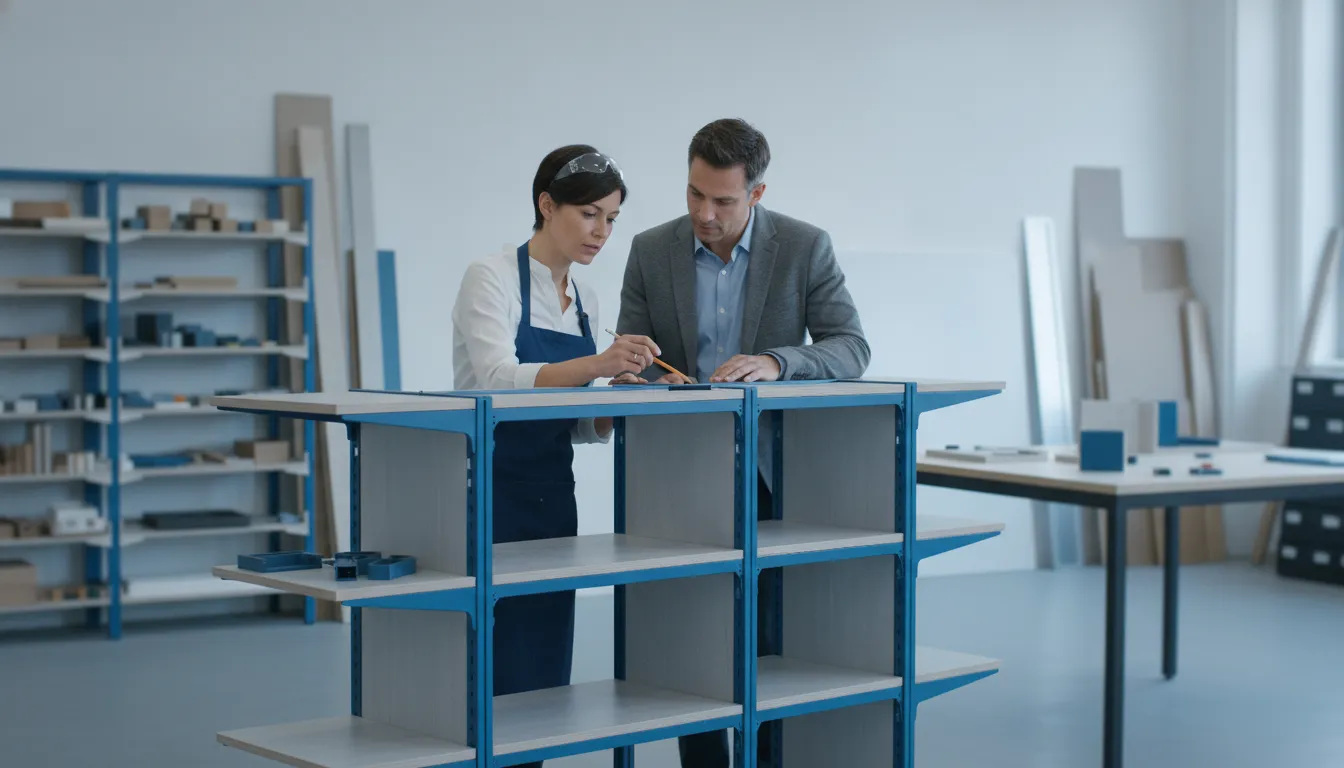


A fixture program can look successful in a sample store and still become difficult to manage across dozens or hundreds of locations. The real test is whether a manufacturing partner can repeat the approved design, protect quality, and coordinate production, inventory, and delivery. That discipline prevents new problems at every step.
The best retail display manufacturers prove rollout readiness with evidence: capacity for your location count, reliable lead times, multi-SKU accuracy, disciplined quality control, and project management that connects design through nationwide distribution.
Discuss your custom retail fixture program with S-CUBE
That evaluation starts before a purchase order is issued. Look past polished product photos and examine how the manufacturer handles the practical demands of scale, from ownership and communication to prototype approval and fulfillment. The first question is whether its operating model is built to deliver the same standard repeatedly.
A product vendor can show you an attractive fixture and provide a unit price. A rollout partner must show how that fixture will be designed, produced, tracked, and delivered repeatedly across a live retail network. That distinction matters when operations, purchasing, and procurement teams are balancing scale, consistency, and speed.
Start with evidence, not a capabilities presentation. Ask whether the manufacturer has the capacity to support programs spanning 500 or more locations, while maintaining consistency across a multi-SKU assortment. Then ask how that capacity is reserved, monitored, and communicated as the rollout progresses. A credible answer should identify accountable people, review points, and escalation paths.
An end-to-end partner can reduce handoffs by combining design, engineering, manufacturing, and logistics under one coordinated program. Review the provider's end-to-end retail fixture services, then compare that operating model with your internal procurement workflow. For additional context on planning a custom retail display, evaluate how specifications, approvals, and delivery requirements connect before production begins.
Rework usually begins before a fixture reaches the factory. A promising concept can still fail when its dimensions, materials, hardware, merchandising function, or installation requirements have not been resolved together. The strongest design, engineering, and prototyping process turns those decisions into a controlled sequence before production approval.
Ask the manufacturer to capture the requirements that will govern the program, not just the visual direction. That should include the products or SKUs the fixture must hold, available floor and wall dimensions. Customer interaction, replenishment access, brand standards, store conditions, safety considerations, and installation constraints. A written discovery record gives procurement, operations, design, and engineering a common reference point.
Request the resulting design brief and specification package. Look for dimensional drawings, finish and material callouts, hardware details, load or use assumptions, and any open decisions. Design and engineering expertise matters because a retail display must satisfy functional, branding, and safety requirements at the same time.
Material selection should connect appearance to real retail use. Ask why each substrate, finish, edge treatment, fastener, and protective element was chosen, and whether the proposed construction can be produced consistently across the planned quantity. A capable partner should also explain where value engineering can control project cost while preserving the display's purpose, durability, and appearance.
This is where designing custom retail displays becomes more than a creative exercise. The design must balance function and appearance, while the engineering review tests whether the concept can be built, packed, transported, installed, and repeated without avoidable changes.
Before mass manufacturing, request a physical prototype or another reviewable sample, documented approval criteria, and a record of revisions. Prototyping gives the team an opportunity to check fit, access, finish, stability, assembly, and the in-store experience before production begins.
Finally, ask for design-for-manufacturing confirmation. The evidence should show that approved specifications have been translated into production-ready drawings, bill-of-materials details, inspection points, packaging requirements, and installation instructions. When those records are complete, production begins from an agreed standard rather than assumptions, reducing late substitutions, repeated approvals, and costly field corrections.
A polished sample does not prove that a fixture program will perform consistently across every store. Ask for evidence showing how the manufacturer selects materials, manages production, inspects finished components, and protects them in transit. The goal is to identify process controls before a defect becomes a rollout delay.
| Evaluation area | Evidence to request | Rollout risk reduced |
|---|---|---|
| Materials and finishes | Material specifications, finish samples, approved standards, and documentation showing how substitutions are reviewed. | Visible variation, premature wear, and brand inconsistency between locations. |
| Production capacity | Capacity plan for the full location count, multi-SKU schedule, staffing model, and lead-time assumptions. | Production bottlenecks and missed store-opening or reset dates. |
| Domestic, international, or hybrid production | A clear explanation of which work is performed domestically or internationally, how capacity is allocated, and how changes are handled. | Supply interruptions and limited flexibility when demand or timing shifts. |
| Quality inspections | Inspection checkpoints, acceptance criteria, defect documentation, corrective-action procedures, and sample inspection records. | Defects reaching stores and inconsistent decisions about what passes. |
| Packaging | Packaging specifications, protection for finished surfaces and hardware, labeling standards, and damage-reporting steps. | Transit damage, missing parts, and installation interruptions. |
| Repeatability | Approved drawings or production references, revision control, repeat-order process, and examples of multi-location or multi-SKU execution. | Dimensional drift, mismatched replacements, and uneven brand presentation. |
Capacity should be tested against the actual program, not described in general terms. A manufacturer evaluation may need to account for 500 or more locations, multiple SKUs, and the precision required to preserve brand standards at scale. Ask how the team would sequence production, approve revisions, and report exceptions before authorizing the full run. Scalability is a core measure because insufficient capacity can create delays even when the initial samples are excellent.
A hybrid model can provide flexibility in cost and lead times by combining domestic and international production. But the model is only useful when responsibilities and handoffs are transparent. Request the sourcing map, quality ownership, backup plans, and communication cadence. This helps procurement distinguish genuine supply-chain resilience from an unclear vendor chain.
Finally, quality control should cover more than the factory floor. It should connect specifications, inspections, packaging, warehousing, and distribution. Review S-CUBE's quality control process to see how a dedicated control framework can support consistency and precision throughout a retail rollout.
A fixture program can fail after production if the manufacturer cannot control what happens between the factory and each store. Evaluate logistics with the same rigor you apply to materials and quality. The strongest retail display manufacturers can manage the full lifecycle, including prototyping, warehousing, and nationwide distribution, while keeping procurement and store operations aligned.
A rollout partner should be judged on repeatable execution, not on a polished portfolio alone. Use this 100-point scorecard to compare retail display manufacturers against the realities of a multi-location program. The categories reflect where inconsistency, missed lead times, or weak coordination can create problems after approval.
Score evidence, not assurances. Give full credit only when a supplier can show a relevant example, process document, sample, report, or named owner. Partial credit is appropriate when the answer is credible but unverified. Zero points is reasonable when the response depends on future planning with no supporting proof.
Use the same questions and evidence standard for every candidate, then set a decision rule before reviewing scores. For example, advance only partners scoring at least 80 overall, with no score below 10 in capacity, logistics, or project management. That guardrail keeps a visually impressive manufacturer from winning while carrying unacceptable rollout risk. This matrix ranks execution strength for your program, not vendor popularity.
Use this evaluation alongside the broader retail fixture manufacturers guide for category context, and compare it with the retail fixture vendor scorecard when you need a reusable procurement worksheet. Those resources support the evaluation process; this article focuses on implementation risk across a live multi-location rollout.
Discuss your next multi-location fixture rollout with S-CUBE.
A good retail display supports the shopping experience, reflects the brand, and performs reliably in the store environment. For a multi-location program, it must also be repeatable across locations, compatible with the required product mix, and practical to ship, install, replenish, and maintain.
Retail display manufacturers, fixture fabricators, design firms, and some general contractors can create or install displays. For a large rollout, look for a partner that can connect design, engineering, manufacturing, project management, and logistics rather than treating installation as an isolated service.
Ask how they manage your location count, multi-SKU requirements, prototypes, quality control, lead-time commitments, warehousing, distribution, and installation coordination. Request examples of comparable rollouts and identify the person responsible for resolving exceptions before production begins.
Yes. A prototype gives your team a chance to validate dimensions, materials, finishes, product fit, brand details, and installation requirements before mass manufacturing. Establish written approval criteria and document any changes so the approved design becomes the production reference.
Use the same scorecard and evidence requirements for every candidate. Weight engineering, production capacity, consistency, project management, logistics, and rollout support alongside design quality. Give higher scores to demonstrated processes, references, and reliable commitments, not simply to attractive renderings or broad promises.
The right manufacturer should make scale, consistency, and implementation easier to manage from the first specification through the final location. If you are comparing partners for a multi-location rollout, discuss your fixture program with S-CUBE Fixtures to explore an approach aligned with your operational requirements. Bring your location count, SKU needs, timing, and rollout priorities so the conversation can focus on practical next steps.
Subscribe for expert insights on fixture design, materials, and modern retail environments.