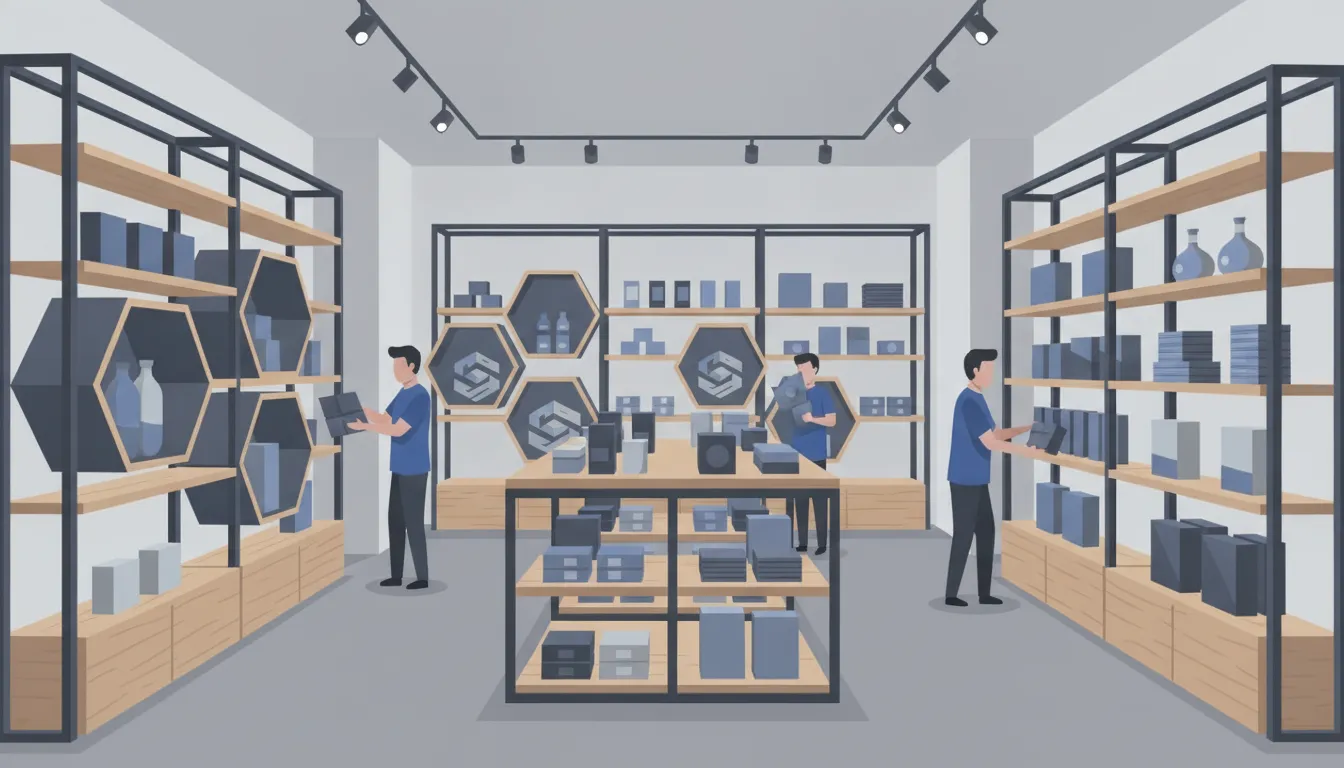


Retail fixtures do more than hold products. They shape how shoppers move through a store and how merchandise is discovered. They also help employees replenish and maintain the sales floor. The right fixture plan supports the retailer's brand, product mix, durability requirements, and rollout realities across one location or many.
In practical terms, what are fixtures in retail? They are purpose-built systems and structures used to display, organize, secure, and support merchandise. Examples include shelving, wall systems, racks, gondolas, cases, tables, and cash wraps. Their design connects the physical environment to merchandising and daily operations.
That definition becomes more useful when you look at what each fixture needs to accomplish. Start with the roles fixtures play, then evaluate the types, materials, design options, and program controls that make a retail environment work consistently.
Explore custom retail fixtures for a store program
Retail fixtures are commercial-grade structures that present merchandise and support the work of running a store. Unlike ordinary household furniture, they are planned around product dimensions, shopper access, replenishment, durability, security, lighting, and the store's visual identity.
A fixture can perform several jobs at once. Shelving organizes an assortment and makes products easier to compare. A display case can improve visibility while controlling access to valuable or fragile merchandise. A cash wrap supports transactions, queue management, storage, and point-of-purchase presentation. Wall systems use vertical space, while tables and specialty units create focal points for featured or seasonal products.
Fixtures also influence movement. Their height, depth, spacing, and placement can open a sightline, create a pause, guide shoppers toward another category, or form an unintended barrier. Penn State Extension advises positioning shelving, cases, and signage to encourage customers to move through the store. The useful principle is broader than any one measurement: fixtures should help the layout work for both customers and employees.
Merchandising gives each fixture a purpose. A display may attract attention, promote a slow-moving item, announce a sale, or introduce a season. The retailer's concept is expressed through materials, finishes, lighting, color, and the relationship between fixtures. For more on these decisions, review retail fixture design principles.
The main fixture types are not interchangeable. Each serves a different merchandising or operational need. Most stores combine several formats rather than relying on one universal unit.
| Type | Best use | Planning note |
|---|---|---|
| Wall systems and shelving | Perimeter merchandise and organized category presentation | Use vertical space while protecting sightlines and replenishment access. |
| Gondolas | Freestanding aisle merchandising | Plan for access from both sides, adjustable shelves, and different back systems. |
| Racks | Apparel, accessories, and hanging merchandise | Consider garment capacity, circulation, shopper access, and visual density. |
| Tables | Featured, folded, seasonal, or bundled merchandise | Place them where shoppers can approach from several sides without narrowing paths. |
| Display cases | Premium, fragile, small, or security-sensitive products | Balance visibility with security, lighting, cleaning, and staff service needs. |
| POP displays | Campaigns, impulse items, and new products | Give the unit a clear objective and location so it attracts attention without clutter. |
| Cash wraps | Checkout, storage, queue support, and associated merchandise | Coordinate counter height, equipment, power, security, and employee workflow. |
Retail-ready programs can include modular perimeter systems, racks, tables, gondolas, and showcases. These options may suit pilots, seasonal displays, and short-run needs. Custom fixtures can align more closely with a retailer's products, brand finishes, and store environment. The starting point should be the job the space must perform, not simply a catalog label.
Think about the fixture as part of a system. A wall unit may need to connect with lighting, signage, adjacent shelving, and a replenishment route. A table may need to preserve circulation while creating a clear product story. A case may need service access as well as a secure presentation. These connections determine whether a fixture supports the whole store or only looks suitable in isolation.
Fixture placement affects what shoppers notice, how they move, and which products receive attention. Begin by mapping the intended path through the store. Protect clear routes for shoppers, carts, strollers, and employees. Penn State Extension offers nine feet as guidance for aisles where two carts or strollers need to pass. Treat that figure as context-specific planning guidance, not a universal code. Store format, local rules, equipment, accessibility, and traffic patterns still control the final design.
Use height, orientation, spacing, and category adjacency to decide what shoppers see first. A focal display can introduce a seasonal collection or establish the visual language for a department. Balance, object scale, color, simplicity, and lighting affect whether the focal point reads clearly. Display density matters too. Tightly packed fixtures may increase capacity but reduce scanability, access, and perceived order.
Define the objective before installation. Track traffic through the area, product interaction, conversion, replenishment effort, and observed bottlenecks when those measures are available. Photograph successful configurations and record what fails before repeating the design across stores. The strongest fixture plan links visual merchandising to evidence, not preference alone.
Custom and modular fixtures serve different needs. Start with the store concept, product assortment, operating requirements, and rollout plan. The choice is not simply between a premium option and a basic option. It is a question of how much the fixture must solve beyond holding merchandise.
Custom fixtures fit projects where dimensions, materials, finishes, or details must align closely with the retailer's identity and environment. They can be developed around product presentation, customer flow, security, lighting, or employee workflow. Custom work is also useful when durability and repeatability need to be defined rather than assumed.
The process may include concept development, CAD or 3D renderings, functional prototypes, design validation, and refinement before production. S-CUBE describes custom capabilities across hardwood, laminates, metal, acrylic, glass, and mixed materials. Its stated process also includes exact specifications, defined quality levels, and custom finishes.
Modular, retail-ready fixtures can suit seasonal programs, pilots, short runs, or assortments that change often. Pre-configured perimeter systems, racks, tables, gondolas, and showcases can help a team test a merchandising approach without committing every store to a fully bespoke build.
Many programs use both approaches. Custom elements establish the branded environment, while modular units support flexible categories or temporary campaigns. Confirm the assortment, durability expectations, replenishment process, future reconfiguration, approved finishes, quality checks, and rollout requirements before choosing a path.
Selection also affects future change. A fixture that can accept approved accessories or shelf adjustments may support assortment updates without a complete replacement. A highly branded unit may justify tighter controls because its details carry more of the store's identity. Document those tradeoffs early so the program remains practical after the first installation.
A controlled process gives retail teams decision points before a full production run. The typical sequence includes:
This sequence reduces avoidable changes when a pilot expands into a broader store program.
The same discipline helps teams compare suppliers. Ask what is included in the design package, who owns the approved drawings, how prototypes are evaluated, and which quality checks occur before shipment. A clear process makes the transition from creative concept to repeatable production easier to manage.
A repeatable rollout ensures that every location receives the right approved fixtures in the right sequence. It connects design, specifications, production, quality control, inventory, delivery, and installation instead of treating them as separate handoffs.
Start with clear ownership. S-CUBE describes assigning a dedicated project manager to each program and coordinating timelines from kickoff through final delivery in its end-to-end retail fixture services. The approved specification should define dimensions, materials, finishes, hardware, packaging, and acceptable tolerances.
Inventory planning then connects the specification to the rollout schedule. Components can be organized by store, department, or installation phase. Kitting and staging reduce the risk of sending a location an incomplete package. Warehousing can hold inventory when stores are not ready to receive everything at once. Phased releases can match construction and opening dates.
Distribution should be planned at the store level. S-CUBE describes transportation, distribution to multiple locations, and kitting as part of its logistics scope. Review its fixture logistics and distribution services when comparing suppliers. A retailer can also use this multi-location fixture rollout planning guide to evaluate program ownership and field execution.
S-CUBE customer materials state that its programs can scale from pilot stores to 500 or more locations and can involve more than 120 SKUs. Attribute these as customer-material claims, not universal requirements. At that scale, stable identifiers, controlled revisions, inventory visibility, and documented store variations become essential.
Common types include wall systems and shelving, gondolas, apparel and specialty racks, tables, display cases, point-of-purchase displays, and cash wraps. The best type depends on merchandise, layout, shopper movement, replenishment, security, and employee workflow.
Examples include perimeter shelving for category organization, a gondola for aisle merchandising, a rack for hanging apparel, a table for a featured assortment. A case for high-value products, a POP unit for a campaign, and a cash wrap for transactions and queue support.
Requirements depend on merchandise, store format, brand standards, local conditions, and installation. Define dimensions, materials, finishes, load needs, hardware, signage, lighting interfaces, packaging, assembly instructions, aisle clearances, staff access, and approved variations before production.
Choose custom when brand-specific dimensions, finishes, durability, security, lighting, or unusual merchandise require engineered control. Choose modular fixtures when speed, flexibility, seasonal use, short runs, or pilot testing matter most. Many programs use both.
Explore custom retail fixtures for your store program
A scalable fixture program benefits from clear specifications, coordinated production, and a rollout plan for each location. When you are ready to define the next phase, describe your project through S-CUBE's custom retail fixtures page. Share your store format, rollout goals, and key fixture requirements so the discussion can focus on a practical path from planning through implementation.
Subscribe for expert insights on fixture design, materials, and modern retail environments.